
AI and syllabi
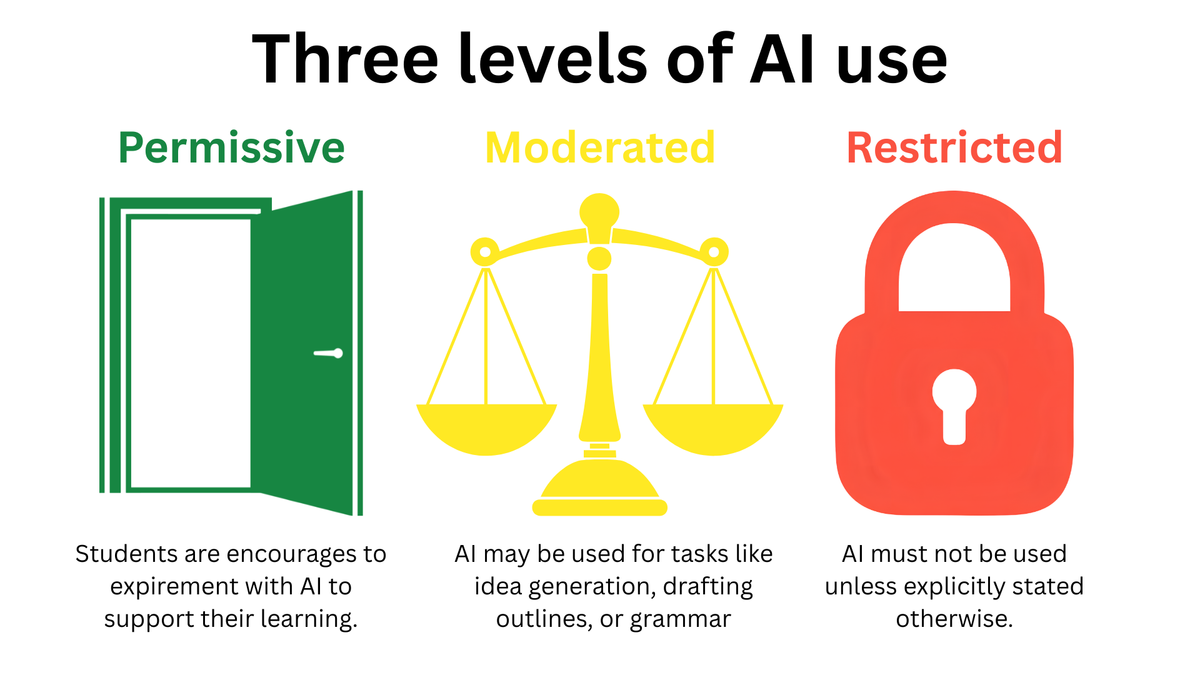
Three-tier guidelines clarify how students can use artificial intelligence in Augustana courses.
This fall, many Augustana students found a new addition to their syllabi: sections outlining instructors’ expectations for the use of artificial intelligence (AI). The addition, which stems from the Undergraduate Curriculum Council (UCC) and the provost’s office, asks instructors to classify their courses into three categories: permissive, moderated, or restrictive, based on how much AI use is allowed.
The addition is intended to clarify when and how students are allowed to use AI as they move between classes with different expectations.
“The syllabus is really supposed to lay out student expectations,” said Alexander Kloth, a neuroscience professor who has adopted the new categories in his own courses. “When you have an instance where a student uses AI that runs afoul of what the professor thinks is appropriate, but it’s never articulated well in the syllabus, that becomes an issue for everybody.”
Senior biology and French major Mariam Alinizi said she welcomes the addition to syllabi. Before, she said, she often had to learn a professor’s AI policy by word of mouth unless it was explicitly spelled out.
“I have seen it a lot more in the syllabus, and I appreciate that it is outlined now,” Alinzi said.
How we got here
Years before the three-tier model was widely adopted, Augustana formed an AI@AU task force to explore integrating AI into academic and administrative settings. The task force compiled a repository of AI tools and information, including sample course policies, on the Mikkelsen Library website.
As early as 2024, the three-tier model appeared on the library’s website. However, the framework was not widely adopted initially, and faculty were encouraged to take different approaches based on their disciplines.
David Golemboski, an associate professor of government and international affairs, said that over time, the absence of any clear communication concerning those policies became a problem.
“Over the last year or so, it became clear that faculty had policies that were all over the map and that is maybe okay, but could be confusing for students,” Golemboski said.
What's new this year is a more formal expectation, pushed by the UCC and the provost's office, that instructors name one of the three categories on their syllabi. The Center for Excellence in Teaching and Scholarship built the three-tier language into the syllabus templates and checklists it distributes each August, and added a checkbox to the semester syllabus submission form asking whether faculty have incorporated a clear AI policy.
Augustana isn’t alone in adopting this kind of structure. Kloth said a number of universities have moved toward multi-tier, “stoplight”-style AI policies, and similar frameworks appear elsewhere. Lamar University’s sorts AI policies into three broad categories: prohibited, permitted with restrictions, or encouraged. University of California, Santa Barbara also recommends a comparable three-tiered approach.
Augustana’s published guidance offers sample language for each tier that instructors can adapt to their own courses.
Under a permissive policy, students are encouraged to use AI freely, including on graded work, but must document which tools they used and how much those tools contributed.
Under a moderated policy, AI can assist with specific tasks like brainstorming, outlining and grammar checks as long as it doesn’t make up the majority of the submitted work, and students must disclose which parts of an assignment were AI-assisted.
Under a restrictive policy, AI use is limited to non-assessment activities such as early-stage research, and submitting AI-generated content as one’s own work is treated as a violation of the university’s honor code.
Courses that fulfill Augustana’s writing requirement carry an additional rule: students who use AI at any point while writing a paper must include a reflection describing how they used it.
Designing around AI
In practice, many instructors use the categories as a starting point rather than a fixed rule. Kloth, for instance, treats his own policy as an assignment-by-assignment decision, spelling out in his syllabus why one task might benefit from AI assistance while others may not.
Kloth is designing a literature research project where students can use AI to refine PubMed search results, but not to summarize papers themselves, since those summaries often just repeat what is already in the abstract.
Despite a push for clearer AI policies, Golemboski said some faculty moved away from trying to catch AI use after the fact.
“It’s almost impossible to definitively prove that someone’s used AI,” Golemboski said.
Instead, some instructors have tried to design assignments that are more difficult to outsource to AI.
Golemboski has applied that approach in his own courses, cutting the long final essay from his constitutional law class in favor of in-class simulations and oral arguments over case law.
Kloth has taken a similar approach in his neuroscience capstone course, where students record video reflections instead of writing essays.
Olivia Hunhoff, a senior psychology major, described a more direct example. Her professor in a counseling and psychotherapy course, Ben Jeppsen, built a custom chatbot that asks students preloaded questions about their own beliefs and matches their answers to psychological schools of thought.
“The thought process was like, I don’t want students to be offloading this work onto AI,” Hunhoff said, “so by having them have to interact with AI for it, they can’t make AI do it for them.”
Hunhoff said she sometimes wonders how her education compares to what students experienced before the proliferation of AI.
“I wonder how different my coursework is, and if my coursework is more or less effective than five years ago, when professors weren’t having to worry about [AI] and modify their courses,” Hunhoff said. “What if I would have been learning better with the resources that they were actually able to give us and trust us to use at that point?”