Four candidates outline visions for Central District seat
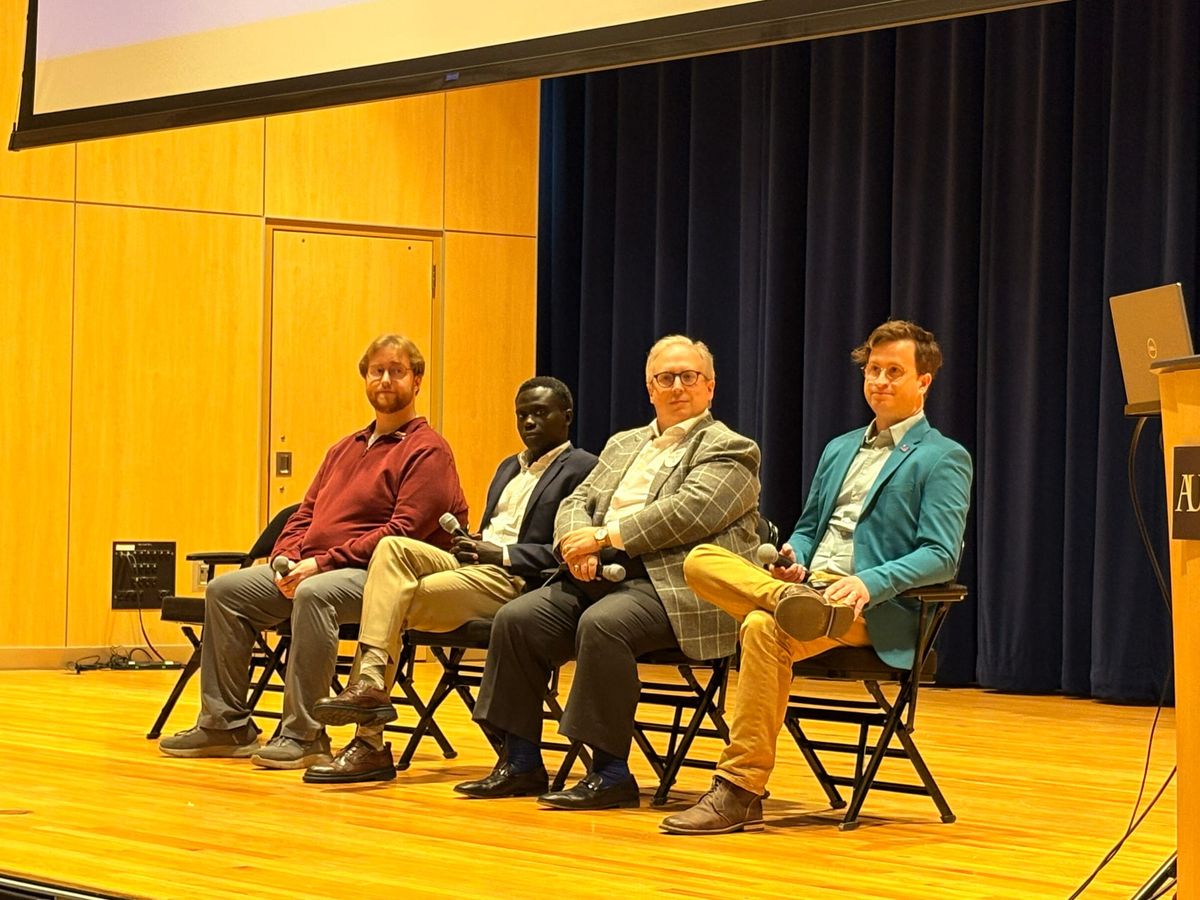
On Wednesday, April 29, four City Council candidates debated in Hamre Hall at a forum organized by seven neighborhood associations from the Central District.
The race is for one of the eight seats on the City Council, the body that approves budgets, zoning and laws that regulate daily life for those who live in Sioux Falls.
Only four of the five candidates attended. Matthew McKinley was not present, did not respond to interview requests made by the local press during the campaign and offered no justification for his absence.
The four who were present each have distinct trajectories. Bob Trzynka is a lawyer and has lived in the Central District for nearly 26 years. Zak Okuwe is a nurse, founder of the NGO STEM the Gap, and arrived in the United States as a South Sudanese refugee at age nine. Zach DeBoer is an artist and educator; in 2018, he lost the same race by 149 votes. Tommy Kunz is 27 years old, works as a delivery app driver and entered the race motivated, according to him, by frustration with the City Council's lack of transparency.
Over two hours, four themes dominated the stage. The housing crisis and the growth of the unhoused population concentrated the most substantive debate of the night, City Council transparency generated the most forceful remarks, and a question about the future of the Minnehaha Coliseum revealed the only clear divide among the four present.
Homelessness
Moderator Megan Raposa ‘15 asked the candidates to evaluate the city's track record regarding the unhoused population up to today, questioning what they would change or keep about the current administration's approach to dealing with this population.
DeBoer advocates for ‘Housing First’ — providing housing before any conditions. He said he personally attended a public hearing to ask why the city does not adopt the policy.
"I think it was a very ‘I want to keep my job’ answer from the person," he said about the response he received.
DeBoer highlighted that the city's current rules require a person to be free of drugs and alcohol to apply for certain housing, which he considers an obstacle. He argued that housing must come before treatment for addiction because it is much easier to seek help or employment when one has a roof over their head.
Kunz agreed and reinforced that the lack of housing creates a cycle of exclusion.
"If you don't have a house, you can't shower regularly,” Kunz said. “You can't get a job. We want to make sure that the city really starts taking the housing first approach and making sure we actually just get people into homes."
Okuwe was more skeptical about the city's role.
"I don't have hope in the city," he said, referring to the possibility of the city solving the problem on its own. Instead, he proposed a community-based solution.
Okuwe explained that if 10 churches each help one person, that would be 10 people off the streets per year. He emphasized that these people also need a “friend;” their families have often already given up on them, and institutions like the Union Gospel Mission are their only resources.
Trzynka was more technical, presenting a distinction between three profiles of unhoused people — chronically unhoused, intermittently unhoused and occasionally unhoused — and argued that each group requires a different response. His focus is on early screening to prevent occasional cases from becoming chronic.
Trzynka also warned that other cities are sending their unhoused populations to Sioux Falls by bus, which requires efficient interception programs. At the end, he brought a personal component to the debate by saying he has close family members who have lived in shelters.
Affordable Housing
Raposa then introduced the topic of housing affordability, connecting it to infill development.
Okuwe reinforced the sense of urgency on the topic.
"As someone who rents and looks forward to buying a home, it really feels like I'm stuck between a rock and a hard place," he said.
Okuwe explained that rent keeps rising — with the median home value close to 300 thousand dollars — while wages are not keeping up with inflation. The solution he proposed is to prioritize increasing supply and urban density, supporting new development projects rather than preserving older structures that can slow the city's growth.
Trzynka argued that development in already urbanized areas (so-called infill) represents the best return on investment for the city. He warned that converting single-family homes into multi-family buildings had been a "failed experiment" in the past, resulting in deterioration. His proposal is to use tax incentives, like Tax Increment Financing, to ensure a mix of incomes in new projects.
Kunz focused his proposal on the Central District itself. He proposed identifying vacant lots and abandoned parking lots for new developments. He emphasized that the city needs to ensure "equitable" housing, safe and in good condition, citing his own experiences in buildings where the state of the hallways was so bad that he "didn't want to live there."
DeBoer advocated for eliminating parking minimums as a way to make "granny flats," or accessory dwelling units, viable. Today, to build an accessory unit for a relative, the city requires two parking spaces — which he considers an absurdity that prevents an increase in urban density.
Transparency
The strongest consensus of the night was on the transparency of the current municipal government. The four candidates present rated the city between 2.5 and 3 on a scale of 1 to 5.
To address this problem, Okuwe proposed public forums at varying times and locations so that residents with jobs and children can also participate.
DeBoer advocated for participatory budgeting — giving citizens more direct say over where public money is spent.
Trzynka pointed to Neighborhood Connect, a tool recently launched by the city, as a step in the right direction but still insufficient.
Kunz cited the votes on data centers as proof that public opinion is not being taken seriously and proposed prohibiting the municipal government from signing NDAs with private companies.
"I believe that if anyone's going to discuss anything with our government that is funded by our tax dollars, that has to be 100% in the public,” Kunz said.
Minnehaha Coliseum
Another topic that generated reactions during the night was the possible demolition of the Minnehaha Coliseum, located on the corner of North Main Avenue and West 5th Street, to make way for office buildings.
DeBoer reinforced the importance of preserving historic buildings that give character to Sioux Falls.
"We need to do everything we can to preserve not only obvious things like the Coliseum," he said. "We can't let them just bulldoze buildings for parking lots or a drive-through."
Kunz said he did not believe the news when he saw it and called for a firm response from the municipal government.
"I do believe that we need a strong responsibility from the citizens and from the city government that this is not something that we want," Kunz said.
Trzynka was the most categorical. He recalled that the city had already demolished other historic buildings with the promise of progress — and regretted it.
"So it seems like it's a broken record where, you know, every 20 years or so somebody in the district level will say, ‘Hey, you know what the solution is to our downtown? Let's tear down our historic buildings and replace them with other buildings,’” Trzynka said. "That's not the solution."
He said he is actively working with local groups to find a solution that preserves the Coliseum while still meeting the county's expansion needs.
Okuwe was the only one to disagree. He said he trusts the advice of a local historian, who has said sometimes "it is necessary to yield to progress." Okuwe proposed building a new administrative building on an adjacent area before any decision but made clear he would follow public opinion.
"I'm for progress," Okuwe said. "But at the same time, I think public input is important. I hear what the public wants, and I'm going to vote based on that."
***
In the last question of the night, each candidate imagined Sioux Falls one year after taking office and what Central District residents would have to show for it.
DeBoer called for slower and safer streets in front of every home. He cited a project he already conducted in the city — the simple marking of parking lanes, which reduced the average car speed on 18th Street from 34 to 28 miles per hour.
"So that's six miles per hour, and that doesn't seem like a lot,” DeBoer said. “But that amount means the world to your health, the likelihood of your survival, your pets, your kids. Everybody needs safer streets."
Kunz promised to restore trust in city government through informal forums, constituents who are informed about every meeting and a city hall that listens before deciding.
"There's no way to get any larger projects done if we don't have the public support," he said.
Okuwe said he will build relationships with non-governmental organizations, churches, businesses and state legislators, and that this will be his differentiator.
"Action speaks louder for me, and I intend on being a council of action," Okuwe said.
Trzynka bet on the combination of his two careers and his ability to build coalitions. He drew genuine laughs from the audience by telling the story of a legal dispute with another lawyer — and how, two days later, the two were already sitting together seeking solutions to another problem, which even earned him a campaign contribution from his opponent.
"And that's the kind of leadership that we need," Trzynka said. "Someone that knows how to fight and knows how to work together."
On June 2, Central District residents and those from three other Sioux Falls districts will choose who will occupy the seat.