Augustana hosts hands-on AI summit with Google
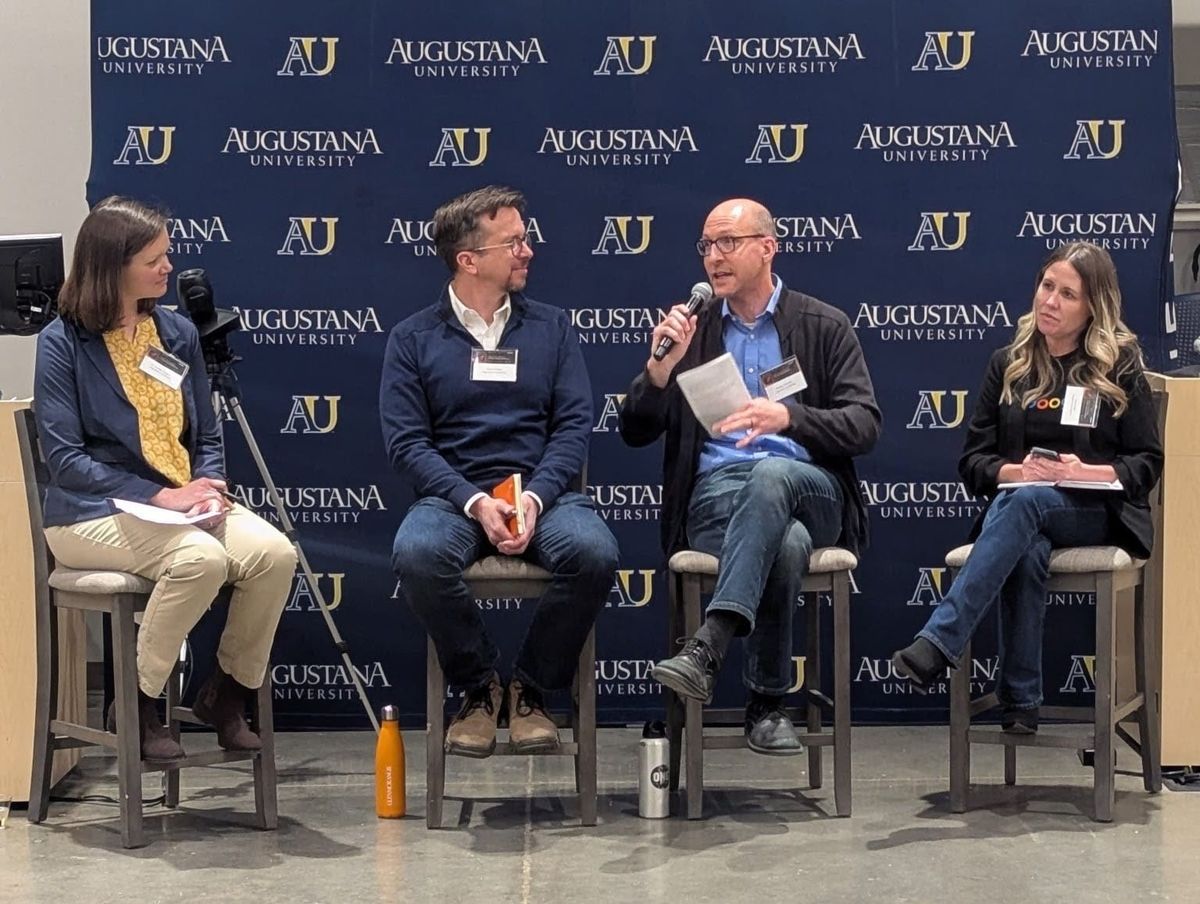
A combination of students, faculty and community members gathered in the Froiland Science Complex on April 8 to discuss the future of artificial intelligence (AI) during an applied AI summit.
The event was hosted by Augustana in collaboration with Google Public Sector — a subsidiary of Google aimed at helping educational and government institutions adopt AI — and Carahsoft Technology Corp.
The hands-on event focused on applied uses of AI across various fields. The summit featured several components, including breakout sessions, a demonstration of Google’s NotebookLM and discussion panels on the ethics of AI, as well as AI across different industries.
A total of 198 people attended, coming from Augustana, the Sioux Falls community and the surrounding region.
Vice President of Innovation Pete Folliard had previously been invited to similar summits hosted by Google Public Sector in Chicago and at Purdue University, which prompted him to decide to bring a similar event to Augustana.
“This is the fourth one I’ve done where I’m presenting, so I’ve been able to see what works, see what doesn’t work, and think about what works best for Augustana,” Folliard said. “I’m so pleased it all came together, and we feel good about it.”
Two separate breakout sessions during the first half of the event covered four topics, including AI in education, healthcare, business and other practical applications.
The education session presented speakers from both Augustana and surrounding school districts: Brad Uhing, an Augustana professor of education, Michael Amolins, an adjunct professor of education for Augustana and the director of academic services for the Harrisburg School District, and Sarah Burkett, the Sioux Falls School District’s AI workgroup coordinator.
Within the education program at Augustana, students are learning how to incorporate AI into their future classrooms. Amolin said local school districts have also begun looking at how AI can be used by teachers, pointing out that it has the potential to reduce the amount of time spent on clerical work, especially after the school day.
“During the day, there’s less of a mad rush to do all these things, and instead they can focus on the relational aspect,” Amolins said. “If anything, it allows them to have a firmer foundation and eliminate some of the extra hours they’re not getting paid for.”
The second session discussed how AI interacts with the field of healthcare. According to that session and the event’s keynote speaker Jen McKay — a senior clinical specialist with Google for Health — AI is already active in healthcare, but it’s important to pay attention to how it’s being used.
“I thought it was interesting how often the people on the panel emphasized that this technology can do important things, but they always have to double-check it,” Cody Christiansen, a third-year anthropology and media production double major, said.
The second half of the event contained two panels, which focused on the ethics of AI as well as AI use across different sectors; Augustana faculty and Sioux Falls community members spoke during both. The panels encouraged attendees to engage in thoughtful discussion about the future of AI and how to address it as it develops.
During both panels, attendees expressed concerns about increasing job shortages as the workforce further integrates AI. The panelists noted that although AI may be able to replace some current jobs, such as mass data analysis, there will always be jobs that require humans.
“Sometimes we call the simple work that AI could do ‘dumb work,’ but that’s not the way to talk,” Stephen Minister, professor of philosophy and the Stanley L. Olsen Chair of Moral Values, said. “I think the importance is to figure out how to treat people with dignity as this change happens.”
Minister also said one of the biggest problems with current discussions on AI is that many people are either entirely for it or entirely against it, without providing space for nuanced opinions.
Many at the summit shared this view, noting that these conversations are necessary to establish standards for AI usage.
“I think AI can be used for good things and bad things, but it’s up to us to use it responsibly,” senior marketing and management double major Abigail Kaburugo said. “We shouldn’t be totally apprehensive about using it.”
According to Folliard, this is not the end of discussions surrounding technology at Augustana; rather, it was a step toward figuring out how to address people’s fears and wishes together.
As AI advances, students, faculty and administrators alike are learning how to examine it from all perspectives.
“I think it’s cool that people are excited about technology and trying new things,” Christiansen said. “I just also hope people will be excited about sharing the impacts of this technology, both good and bad.”