More than myth: ‘Hanging Medusa’ reclaims a story
There she stood — a young girl, completely enthralled with the floating ceramic jellyfish and lace tendrils that hung before her. Though she was waiting for her mom to finish talking to a faculty member, she seemed to be perfectly content right where she was. In that moment, only she and the blue-purple ceramics that hovered over the waterfall wall existed.
Though the girl may have seen the portrayal of the mystical creature only for its beauty, the story behind the art waited quietly to be heard.
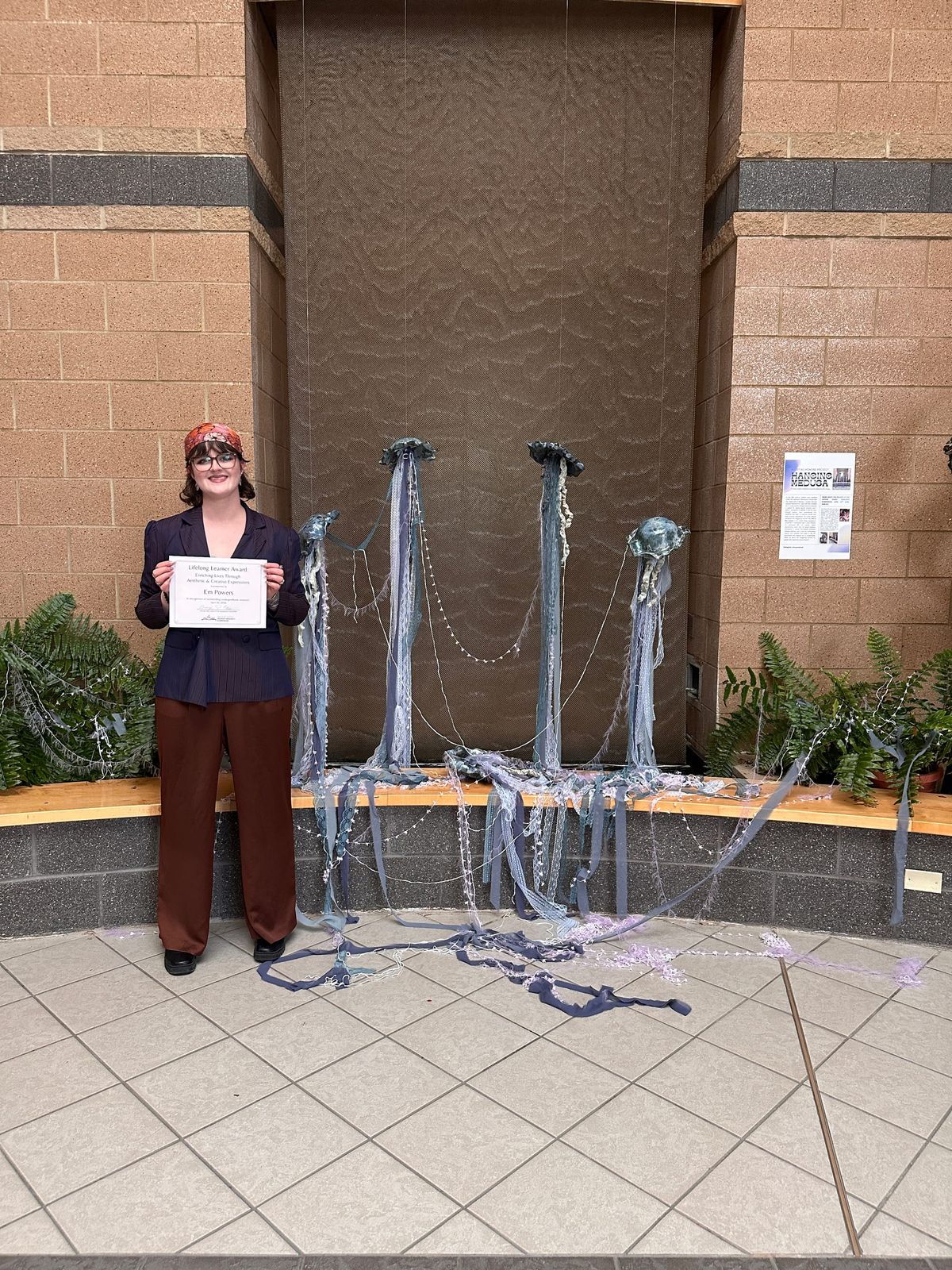
Senior Em Powers, a fine arts major with an emphasis in painting and drawing, displayed their piece “Hanging Medusa” for the 2026 Augustana Senior Art Show and as their Civitas Honors project. As the sculpted jellyfish with their bunches of multi-colored lace and ribbon tendrils rest amongst the ferns in the Center for Visual Arts Atrium, viewers like the young girl captivated by the abstract creation are bound to learn of a larger story.
During the 18th century, jellyfish were classified in the sub-phylum “Medusozoa,” a name rooted in the Greek myth of Medusa — a woman who was punished after being sexually assaulted by the god Poseidon. Today, Medusa’s image has evolved into a powerful symbol for survivors of sexual violence.
“I knew I wanted to tell a story — a piece that would be advocating for sexual assault victims, it was just more so the matter of how,” Powers said.
For a project with such heavy content, Powers intentionally chose a subtle approach to the impactful story through the way she knew best: abstract art.
After learning of the statistic that one in five women in the United States have experienced sexual assault, Powers felt the call to display such jarring information with four hanging ceramic jellyfish and one ‘fallen’ — all connected by one string.
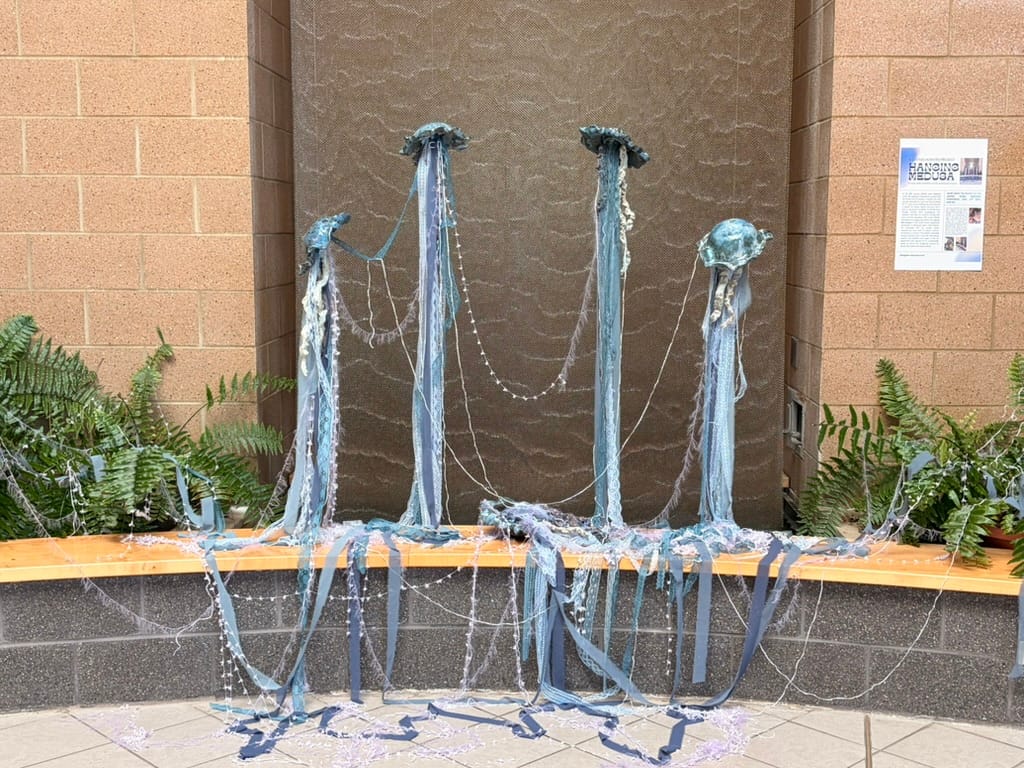
“People should continue to be there for others who’ve survived sexual assault, and they’re still interconnected,” Powers said. “I almost kind of like that people think [one jellyfish] actually fell and it wasn’t intentional. It’s more powerful that way.”
Abstraction — a form of art that focuses on conceptual and emotional portrayals rather than accurate depictions of reality — has served Powers for what they call a “meditational process.”
“If the content’s really heavy, choosing to work in abstraction can make it a little less draining for my body,” Powers said.
For Molly Uravitch, an assistant professor of art who teaches ceramics, the skills Powers showed for 3D art in Ceramics I during her freshman year were hard to deny. Freeforming thin coiling — a technique in pottery created by stacking and joining long ropes of clay in a spiraled fashion — without any errors lit a spark of confidence within Powers to continue expanding her skills.
“They were able to use something that was really a challenging form to be freeform so early on in their journey,” Uravitch said. “I just kept pushing and pushing to see where they would go with that kind of skill.”
As the time to cross the graduation stage approaches, Powers remembers her time at Augustana as both an academic and an artistic journey.
“As a freshman, you don’t know where your work is going to go, and you’re just super open to anything,” Powers said. “Now I’m at the point where I feel a lot more grounded in my work, and there’s more research behind what I do.”
Powers believes that research helped solidify their creations, for which they extend credit to Lindsey Twa, professor of art, who teaches art history courses.
While discussing her role in guiding Powers through their thesis project, Twa said that she thinks the research behind “Hanging Medusa” helped ground the artwork as not only conversational but applicable to the general public.
“They’ve always had a sense of what their subject matter needed to be,” Twa said. “I think they just needed to know their experience is not just individual but that they should be engaged with artists from beyond these walls.”
Powers said that they believe if it weren’t for the community within the art department, she wouldn’t have ended up where she is today as an artist.
“They allow me to just be myself in my work,” Powers said. “I’m someone who is a little ‘I’m going to do what I’m going to do’ mindset, and they have just been encouraging of that.”
This fall, Powers will attend the Minneapolis College of Fine Arts and Design to pursue her Masters of Fine Arts in mixed media with the intention to emphasize in installation art and social justice-based practices.
“It felt really exciting getting to do something that’s installation art, which is what I’m wanting to go into in graduate school and after that,” Powers said. “It definitely does feel like a big capstone to a lot of my work here at Augustana.”
Powers said that one of their goals is to give an emotional outlet for people who find comfort in relating to one another.
“Whether I’m advocating for myself or peers or even a global issue, I just want my art to be about content people can relate to and understand,” Powers said.