No pavement, no problem: Students create their own paths to cut time
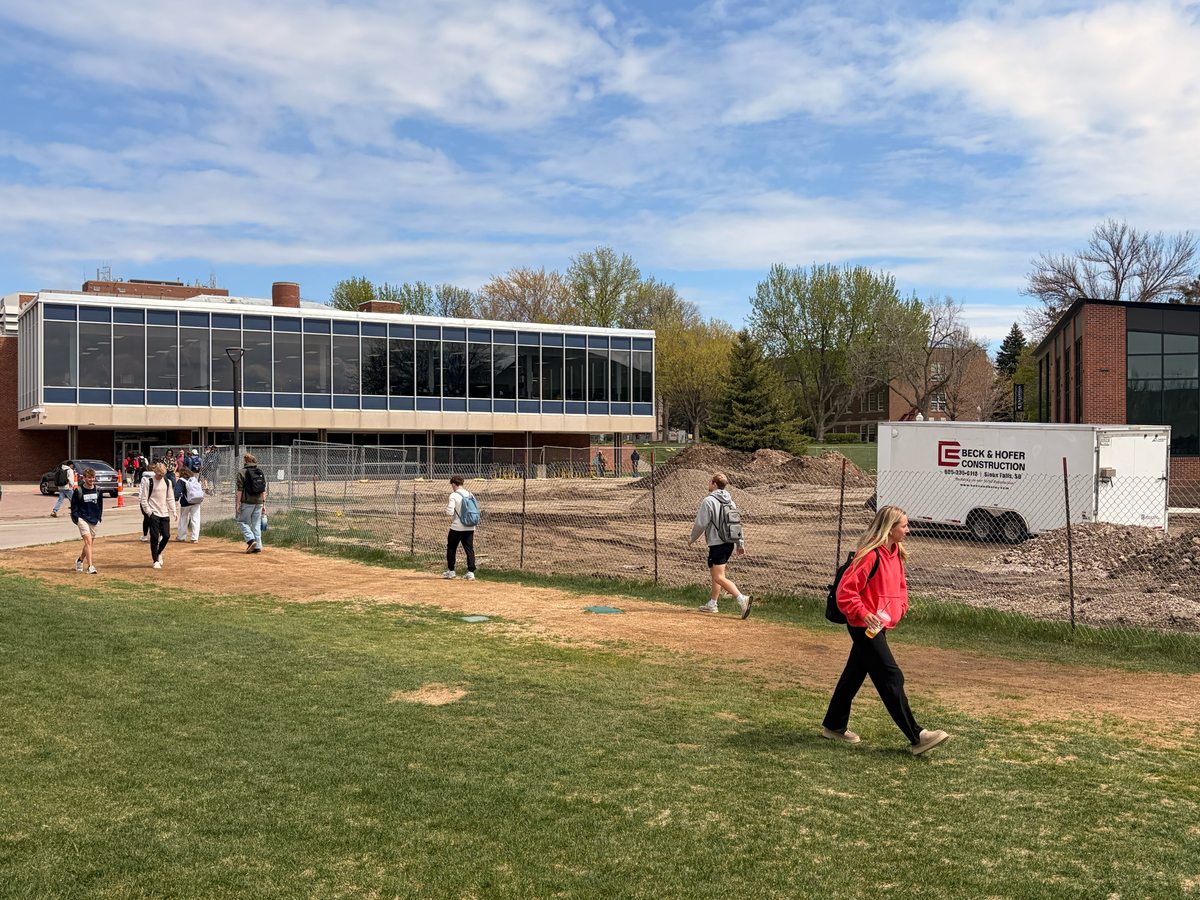
Between the winding, paved sidewalks of Augustana, through landscapes and grass expanses and construction sites alike, a new network is taking form. These high-traffic but unplanned routes are called desire paths, and they are snaking their way into view as students and staff opt for shortcuts to their destinations.
The term “desire path,” first coined by poet and philosopher Gaston Bachelard in 1958, refers to a path that gets travelers from one point to another faster than intentional walkways like sidewalks. These paths tend to appear in walkable areas, and since most of Augustana’s campus is connected via sidewalks and green areas rather than roads or crosswalks, desire paths are both possible and common.
The most popular desire path currently on campus lies along the west-facing fence of the chapel reconstruction project, marked by a four-foot strip of flattened yellow grass. Another path, a muddy upward slope littered with rocks and gravel, connects the alley behind Wagoner Hall to the doors of Solberg Hall. A smaller dirt path also meanders around the tennis courts and eventually merges into this larger desire path between the dorm buildings.
Rick Tupper, associate vice president of campus safety, keeps an eye on blossoming desire paths around campus to understand where new sidewalks might be helpful.
“If we put [sidewalks] there, it doesn’t mean [students] are going to use them,” Tupper said. “They’re going to use what they feel is the most convenient, so it’s best for us to watch where that is and then put the sidewalks in.”
This strategy is not just based on convenience, though. In addition to making students’ commutes through campus easier, watching for the appearance of desire paths allows officials like Tupper to make cost-effective decisions related to new sidewalks.
“You do try to watch [desire paths] a little before you start because, you know, concrete sidewalks are expensive,” Tupper said.
Though desire paths can help connect walkers to their destinations faster, Nick Jackson, instructor of education, raised the concern that they might actually be hindering our connections to others.
“Does a desire path take away human connection, or does it supply human connection?” he said. “If you’re trying to get to a place quickly, you’re missing out on things around you. One of the things around you is people, so you are missing out on an opportunity to connect.”
Despite the potential loss of connection associated with using desire paths, some students simply want to be able to get where they are going quickly and do not pay much attention to potential interactions on the sidewalks of campus.
“People don’t always have the time to walk around and socialize when they have a packed schedule and want a quicker path from point A to point B,” sophomore Jocelyn Dirksen said. “That extra time could be used to relax, to get food, to socialize or to work on homework.”
One former desire path that was recently converted to a concrete sidewalk cuts diagonally from the Mikkelsen Library to the Chapel of Reconciliation. Before this concrete was laid in early April, one could commute between the chapel and the library using existing sidewalks, but it required travelers to do extra walking and make a sharp, 45-degree turn before arriving at their intended destination.
Even though the new sidewalk was not strictly necessary, Tupper said that he understands that efficiently getting people where they want to go is a priority.
One of the next locations being evaluated for a sidewalk is the path from the Fryxell Humanities Center parking lot to the back of Wagoner. Because Wagoner does not have a dedicated parking lot, students who live there often get a parking pass for the Humanities lot instead. After parking their cars, students cross Commons Drive before taking the desire path through the grass and past the Center for Visual Arts to get to their dorms.
“I have a cost estimate to build a sidewalk from here to here,” Tupper said, pointing on a large map of campus to the start and end points of the desire path between the Humanities lot and the Wagoner back alley. “That would then connect the [Humanities] parking lot to [Wagoner], so this would probably be the next area that we really need to look at.”
Once the Humanities-Wagoner path is paved, Tupper would like to see another sidewalk over the Wagoner-Solberg desire path.
“[We] could also connect all of this, basically have a sidewalk all the way from Solberg to the Humanities parking lot,” he said, making a circular gesture around both dorm buildings and the grass area that separates the Wagoner alley from Commons Drive.
While desire paths can indicate where sidewalks might be laid in the future, their appearance during temporary projects like the chapel renovation are not always indicative of where people will be walking permanently.
Once construction on the chapel is complete and the fence is removed, the sidewalk that previously connected the main walking loops to the Morrison Commons will once again be available just a few yards away. This makes the current desire path in that area an unlikely candidate to be paved for permanent use.
“Ultimately, when the construction part is done, we’ll re-sod the area and get it back to being grass,” Tupper said.
Regardless of how the paths are perceived by students and faculty or managed by campus officials, desire paths are a prominent part of life at Augustana.
As campus continues to grow, these paths will reveal where we are going and how we are getting there while also emphasizing broader themes about our connections with both people and places.