J1: Round 2
This spring marked the second time Augustana students registered for classes using the new Jenzabar One software (J1). For many, it went more smoothly than the first.
Still, some students ran into difficulties registering, and frustrations with missing features that existed in the old system persist.
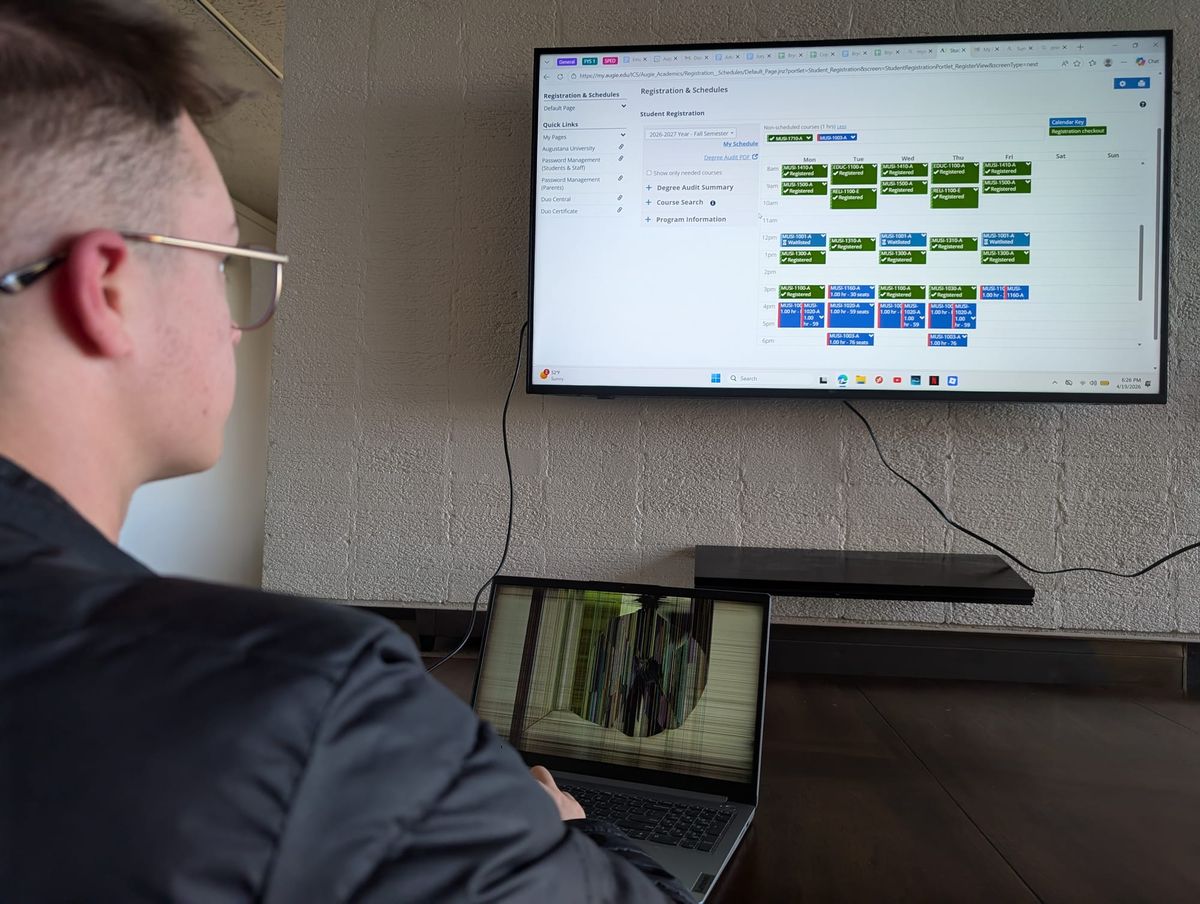
Freshman music education major Bryce Bowman was set to register at 7 a.m. on Thursday, April 24. By 7:05 a.m., Bowman found out that a financial hold prevented him from registering — something he said no one had communicated beforehand. Upon realizing this, he punched his laptop out of frustration, cracking the screen.
Bowman later found that the hold was due to delayed payment processing from the state and federal government for his service in the National Guard.
“I had the understanding from my advisors and from different faculty that my tuition was fully paid,” he said.
With his laptop screen broken, Bowman switched over to his iPad and made his way to the business office when it opened at 8 a.m.
After speaking to four different people, Bowman was eventually granted access to register, but he missed out on registering for his preferred professors in two courses.
For many students though, their registration was far less eventful than Bowman’s.
Registrar Ann Kolbrek and her team set up a pop-up support table in the Mikkelsen Library to assist students with any issues. To Kolbrek, the lack of students coming to the table was a good sign.
“By all accounts, things are going much better even than they did in the fall,” Kolbrek said. “I would call it a marked improvement.”
The first registration using J1 during the fall semester was challenging. Bandwidth issues slowed loading times, prerequisite overrides didn’t work as intended and registration for each grade opened at 8 a.m., the same time many classes begin.
For spring, the university’s IT department secured additional bandwidth and developed a workaround allowing the Registrar’s Office to issue overrides for students who emailed ahead. Additionally, moving registration to 7 a.m. ensured it would not interfere with 8 a.m. classes.
Despite these changes, students’ experiences varied.
Like Bowman, Freshman Hallie Carlson, a double major in psychology and social work, registered on Thursday, the final day for registration. Of the five courses she registered for, she was waitlisted for three: Religion, Medicine and Ethics; Psychopathology; and Art Since 1945. She said she had spent hours creating a schedule that fulfilled both her Via Viking and major requirements.
“It was a lot of planning to kind of get the perfect result,” Carlson said. “And so for all of that hard work to get me waitlisted was very disappointing.”
Carlson attributed much of her difficulty to Augustana’s smaller class sizes, which limit enrollment especially for students with later registration dates.
Not all freshmen struggled though. Sebastian Castle, an undeclared first-year who also registered Thursday, said he got into all but one class. He attributed his smoother experience to selecting mostly introductory courses with large enrollment caps.
“I woke up at 7 a.m., clicked checkout and I was good,” Castle said.
Junior Olivia Hunhoff, a psychology major, said her registration went relatively smoothly. However, she pointed to the absence of the academic planner, a feature from the previous software that allowed students to map out and track requirements, as a source of anxiety.
“I don’t know if everyone else feels that frustrated about not having it,” Hunhoff said. “But I’m constantly trying to make sure I have all of my boxes checked.”
Kolbrek acknowledged that several of the features from the old software have yet to be replicated in J1 and modifying J1 to include custom features will be a years-long process. One new feature, the ability to register directly off a degree audit, has been beneficial.
“I helped a student yesterday, and I was like, ‘Oh, this is slick,’” Kolbrek said.
Faculty members are adjusting alongside students. Sarah Rude, an associate professor of English, said she has learned J1’s advising functions mostly through informal conversations with colleagues rather than any formal training.
“I just wish that someone could do that kind of simple training — just like, hey, this is how this interface works,” Rude said.
Rude also said the new Via Viking curriculum has added advising complexities independent of the software transition. She said this tradeoff comes with the new curriculum’s flexibility.
“If we want to have something that can be personalized to the student, that means we’re going to have to focus on every student individually,” Rude said.
For Kolbrek, her message to students navigating registration was simple.
“Almost everything is always fixable,” she said. “It might not be the perfect solution, but there’s almost always something we can work out.”