Humanities see enrollment rebound
Augustana’s Humanities division recorded a 6.5% increase in majors this past year, a statistical rebound documented in the 2025 Academic Fact Book that coincided with the largest total student body (2,544) and largest incoming freshman class in Augustana’s history (615).
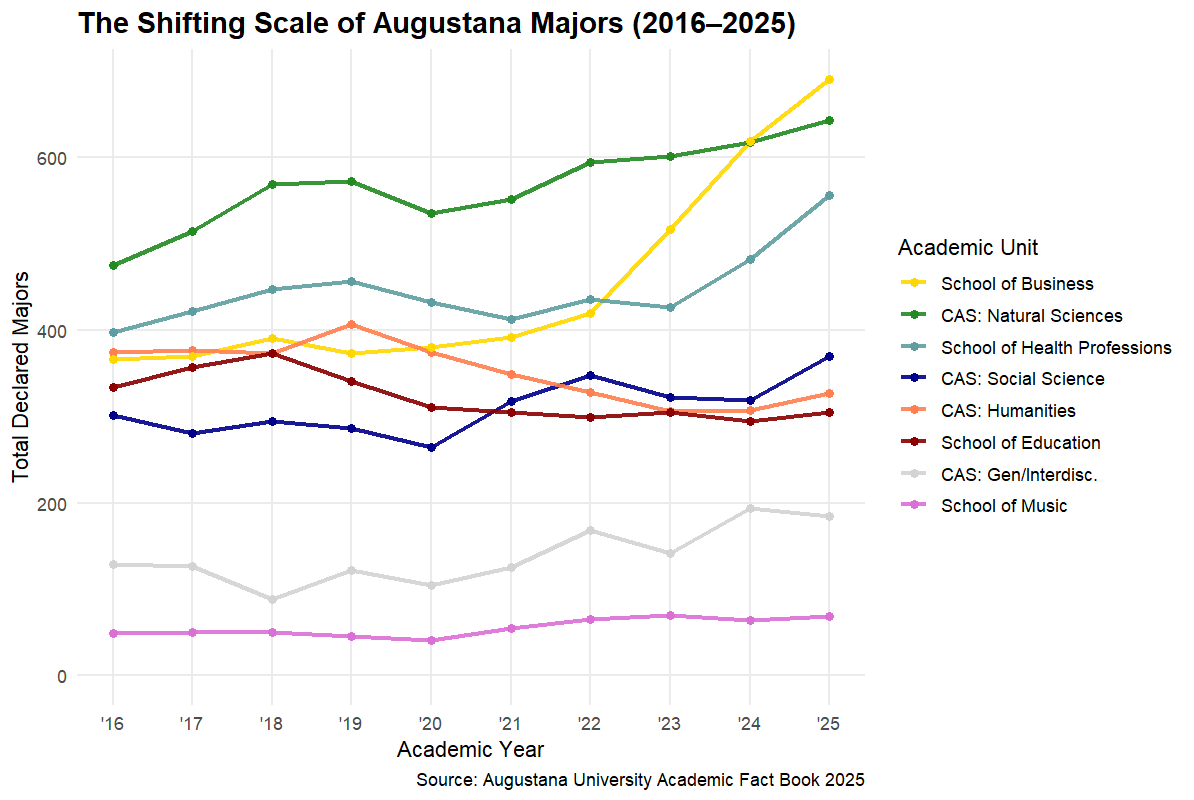
While the university saw increased enrollment across seven of eight academic units, the Humanities’ 6.5% increase (307 to 327 majors) was its first significant increase in years. The Humanities notably outpaced the the 4.2% growth in the Natural Sciences and the 3.4% gain in the School of Education.
The Humanities fell short of the 16% growth seen in the Social Sciences and the 15.4% jump in the School of Health Professions. Conversely, the university’s General and Interdisciplinary unit was the only body to see a contraction, falling 4.6%.
To track these shifts, the university uses eight academic units as defined in the 2025 Academic Fact Book: College of Arts and Sciences (CAS): Humanities, CAS: Natural Sciences, CAS: Social Sciences, CAS: Gen/Interdisc, School of Business, School of Health Professions, School of Education and School of Music.
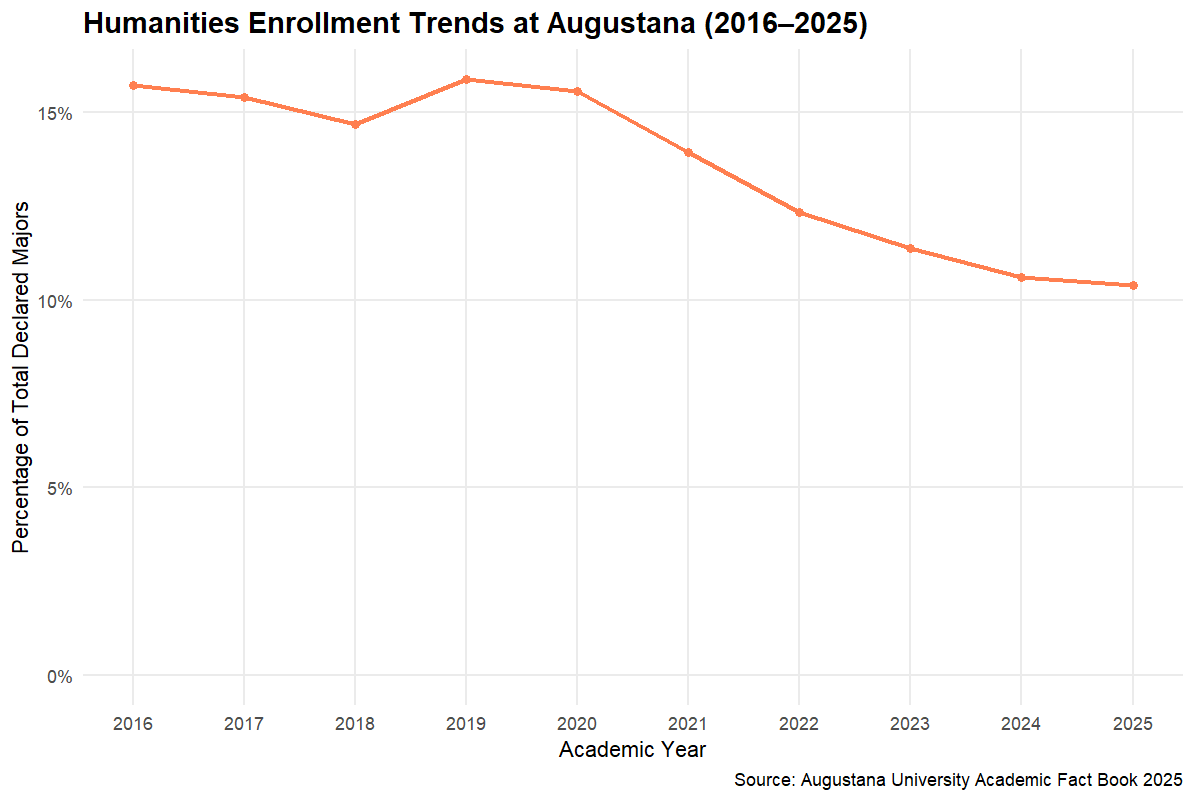
While the total number of majors is rising, the Humanities occupy a smaller proportional share of the campus than they did a decade ago. In 2016, Humanities majors accounted for 15.4% of all majors at Augustana; by 2025, that share decreased to 10.4%.
This proportional shift is largely driven by explosive growth in professional sectors since 2016. The School of Business has more than doubled its enrollment, jumping from 320 to 690 majors — a 115.6% increase.
Similarly, the School of Health Professions and School of Natural Sciences saw significant increases of 39.7% and 35.4% respectively.
Augustana’s recent rebound in total Humanities majors stands in contrast to national trends. According to the American Academy of Arts and Sciences, between 2012 and 2022, the number of undergraduate degrees awarded in the Humanities fell 24% nationwide.
Professor of English and Writer-in-Residence Patrick Hicks attributes part of this downward shift to the perceived value of a degree in the Humanities.
“College is expensive, and I think that students are under pressure from their parents, in some cases, to major in something that the parents can see is going to result in a job after four years,” Hicks said. “But that’s the great irony as far as I’m concerned, because if you really want job security, become an English major.”
Hicks believes the Humanities actually offer superior long-term job security by developing writing, research and empathy-based “soft skills.”
“These are all things that employers want, but I have to work harder to connect the dots to prospective students that want to be an English major,” Hicks said.
David O’Hara, professor of philosophy, classics and environmental studies, says the problem runs deeper than student perception. Humanities disciplines, he said, suffer from a failure of public imagination. Study French, and people assume you’ll teach French. The more expansive possibilities rarely get articulated.
“Universities don’t tend to do a very good job of teaching the people outside of the university the value of the things that you teach inside the university,” O’Hara said.
Federal arts funding cuts under the Trump administration last year have made that case harder to argue. Hicks said the South Dakota Humanities Council was forced to cut roughly 70% of its budget, a move he said directly impacted his ability to speak at high schools about writing and the Holocaust.
“Fortunately, Augustana has stepped up so that I can continue to do that, but it’s taken a huge toll,” Hicks said. “It’s demoralizing to see what the federal government is spending money on when there are cuts to education grants.”
The proliferation of artificial intelligence (AI) has also added pressure to the Humanities. These tools can generate essays and summarize texts in seconds, doing mechanically what Humanities programs have long taught students to do with intention.
Hicks draws a hard line in his creative writing courses and said AI has no place in his curriculum.
“I worry about the rise of AI when it comes to writing,” Hicks said. “We are turning out graduates that, quite frankly, I don’t think know how to write, and that is a deep concern to me. It’s not just putting words together, AI can do that. It’s the process of writing.”
While Hicks remains deeply skeptical of AI, Jennifer Gubbels, dean of the College of Arts and Sciences, does not see AI as a threat to the Humanities.
“We can use AI as a tool in some ways to help us do tasks, but at the end of the day, the Humanities are what makes us human, and there’s nothing that can interfere with that,” Gubbels said.
Gubbels believes that preparing students to use AI thoughtfully should be a part of Augustana’s education.
“We do need to teach our students how to use the tools, how to use them well, how to think about the ethical considerations of using them, because they’re going to encounter [AI] when they leave here,” Gubbels said.
Gubbels’ broader vision for the CAS leans into double majors like as business and English or biology and theater alongside interdisciplinary programs that help students combine professional ambition with humanistic depth.
“We want to challenge students to think about what can I do to make this the best experience possible for myself,” Gubbels said. “In 2030, hopefully we look back and say, wow, look how far we’ve come.”
Whether this past year’s rebound is a turning point or a blip remains an open question. The 6.5% jump in Humanities majors coincided with the largest incoming freshman class in Augustana’s history. Enrollment grew across nearly every academic unit on campus. What the data cannot yet answer is whether the division’s proportional share, down from 15.4% in 2016 to 10.3% today, will continue to erode as Augustana’s professional schools continue to grow.