
Movie review: ‘You Can See Everything’
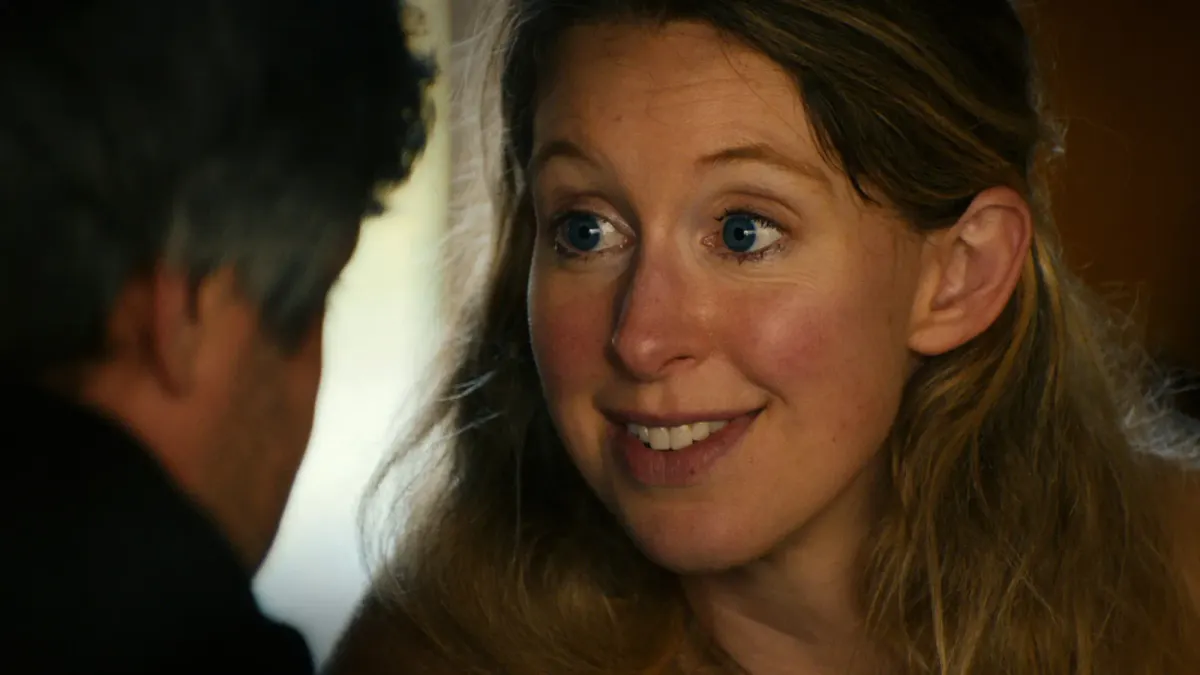
“Why would I deceive you?”
Well that’s the million-dollar question, Liz. The question you posed to Nathan Fielder with your bulging blue eyes open wide — eyes that bore into his soul and my own as I watched “You Can See Everything.” Your blond hair was wild and in need of a brushing. Your lips were chapped, your foundation was unblended; always happy to look a mess. But for those three hours I spent in the cinema, your eyes were all I could focus on. A week later, they still haunt me.
For those who are unfamiliar with the disgraced Silicon Valley sweetheart, Elizabeth Holmes founded her infamous health technology company Theranos in 2003 after dropping out of Stanford. She spent years building the company alongside her ex-boyfriend and the company’s COO and president, Sunny Balwani.
The entire operation centered around one invention: A machine called the Edison that could run hundreds of tests on a single drop of blood. The only issue was that Holmes’ machine never actually worked. Not in practice, at least. But she forged ahead, defrauding investors of over $700 million on the pretense that it did.
The whole thing blew up in 2015 when an undercover reporter from the Wall Street Journal exposed the company’s fraud. Holmes was charged with one count of conspiracy to defraud investors and three counts of wire fraud in 2022, and she was sentenced to 11 years and three months in federal prison. Balwani was found guilty on all 12 counts of conspiracy and fraud and is serving a nearly 13-year sentence.
In 2023, 34 days before reporting to FPC Bryan in Texas to begin her reduced ten-year sentence, Holmes and her husband Billy Evans invited comedian and writer Nathan Fielder (“Nathan For You,” “The Rehearsal”) and a film crew to live with them at their San Diego beach rental. Co-directed with Lance Oppenheim, the footage Fielder shot makes up the first half of “You Can See Everything” up until the very moment Holmes walks into prison.
Part one works almost as Holmes and Evans intended in the sense that it forces us to see her differently. The red-lip-sticked, black turtleneck-sporting fraudulent CEO is now a wife and a mother to two toddlers.
But choosing Fielder to tell their story backfired. The unreadable, awkward persona he adopts in his work visibly throws the couple off-kilter. Holmes overcompensates with intense eye contact and constantly pivots back to her mantra of innocence.
Evans clearly thought he could manipulate Fielder and control the documentary’s narrative, but realizes quickly that Fielder is more keen than he lets on.
Fielder presents us with an indelible picture of Holmes’ final month. He lingers on the bizarre domesticity of it all, letting the camera hold on quiet, uncomfortably protracted moments as she packs Tupperware, feeds her babies and strolls the San Diego coastline with a looming prison sentence hanging over her head.
Through his lens the theatrical, baritone-voiced tech titan becomes a painfully ordinary person, yet no less calculating. Fielder refuses to fill the silences or offer easy reassurance, forcing the audience to sit in the tension of a woman desperately trying to perform maternal warmth while the clock ticks down on her freedom, leaving us to wonder where the real Elizabeth ends and the latest “character” begins.
May 30. Fielder rides along with Holmes and Evans on their way to Texas. We watch Liz walk inside the prison in her beloved beige sweater, and we won’t see her again until Feb. 22, 2030.
Stripped of its central subject, the second half of “You Can See Everything” undergoes a jarring tonal pivot, peeling back the curated illusion Holmes and Evans worked hard to create. We also see the emergence of two players: the real Evans, smarmy and narcissistic, and Amanda Seyfried, who portrayed Holmes in Hulu’s 2022 miniseries “The Dropout.”
Evans steps out from behind his wife’s shadow and becomes her vengeful, self-appointed handler. He pretends his crusade is for Holmes’ benefit — he’s “building monuments of love” to her — and armed with power of attorney and full control of her social media presence, he’s virtually unstoppable.
But behind closed doors with Fielder, we learn that Evans actively pushed to profit off the documentary without being fully transparent with Holmes, all while threatening to ruin everyone involved with “The Dropout.” When Seyfried enters the frame to confront him, Evans lashes out and completely disrespects her, showing his true colors.
Seyfried’s presence is Fielder’s masterstroke, grounding the circus with her sharp moral clarity. Having spent months in Holmes’ skin, she recognizes the couple’s manipulative choreography and calls out Evans’ narcissism.
She’s also a mirror and a sounding board for Fielder — the notoriously detached documentarian found himself slipping up over the course of filming, and Seyfried helps puncture that spell by calling him out on the fact that he’s grown to care for Holmes.
Yet even from a prison cell — and during a surreal phone call where she casually says hello to the actress who played her on TV — Holmes refuses to drop the myth. Whether she’s weeping while watching “The Dropout’s” depiction of her or arguing the semantics of what she meant by saying the Edison “can” work, Holmes remains locked in her delusion.
Throughout all of it, Fielder’s stylistic choices elevate what could have been a tabloid spectacle into something unsettling and borderline absurd. The stark, deliberate and often close-up cinematography frames Holmes and Evans less like real people and more like characters trapped inside a stage play of their own making.
Fielder’s camera pokes holes in the polished Silicon Valley mythology, leaving us with the raw mechanics of self-delusion. He turns the film’s title into an indictment rather than an invitation. You really can see everything.
Elizabeth Holmes, you are quite possibly this world’s greatest enigma. It’s impossible to tell if you are genuine, delusional or a sociopathic manipulator. Regardless, what I saw on that cinema screen was a disgraced founder who always wanted to emulate Steve Jobs and will carry that broken, singular idea to her grave.