Alcohol referrals double, crime falls in safety report
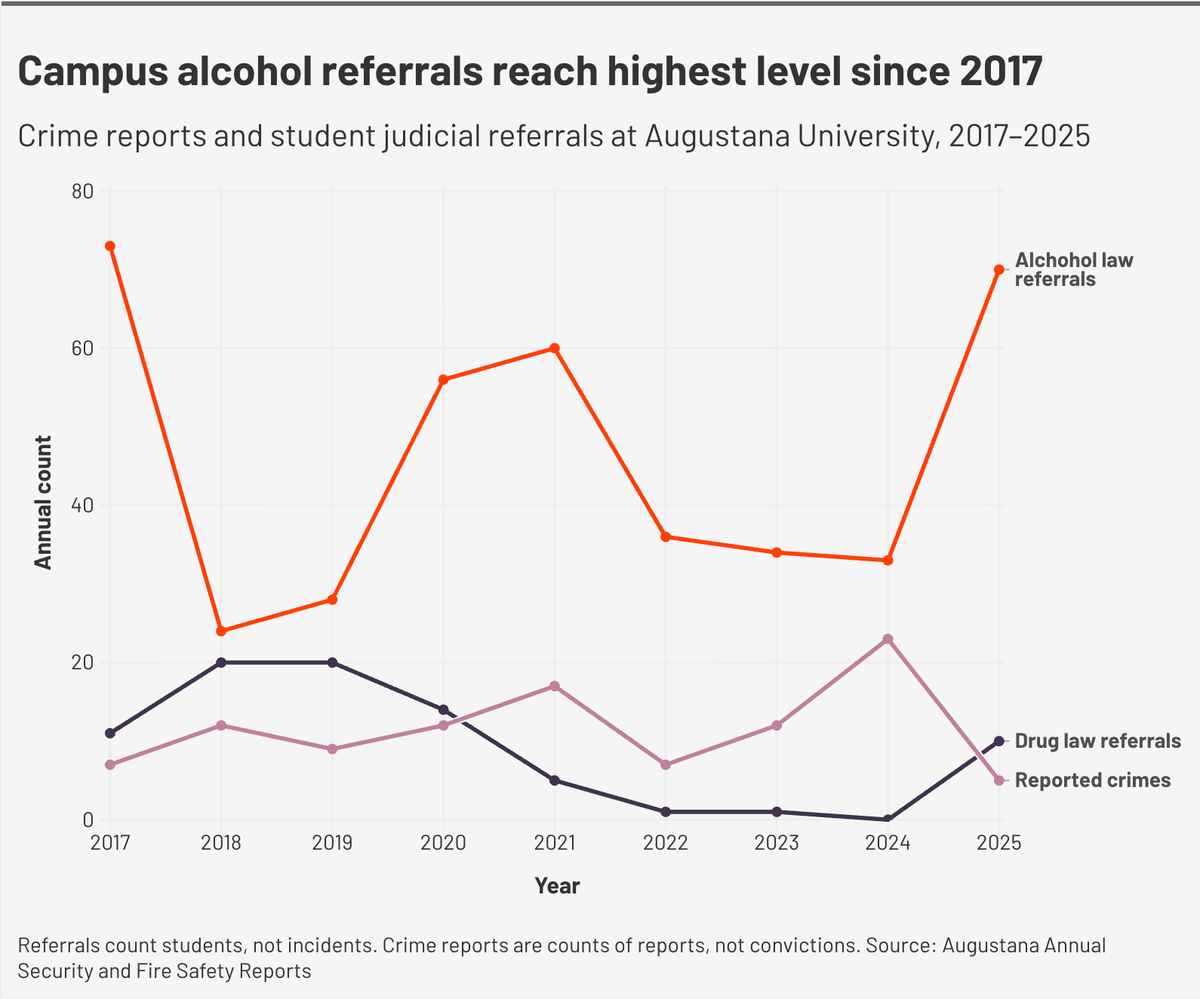
Seventy Augustana students were referred to the judicial system for alcohol violations in 2025, more than double the year before.
Rick Tupper, associate vice president of campus safety, said he can’t point to a specific cause.
“It’s both the approach the students have towards alcohol use, and then on the other side it’s also the approach of the residence hall staff and how they’re enforcing it,” Tupper said.
The figure comes from Augustana’s most recent Annual Security and Fire Safety Report, which the college publishes each year as required by the federal Clery Act. Each of the 70 referrals happened in college-owned housing, and each referral represents an individual student rather than an incident. Drug referrals also climbed, from zero in 2024 to 10, though still below the 14 recorded in 2020. Together, referrals for substance use reached 80 — the most since 2017.
Over the same period, serious crime reports fell. Augustana reported five in 2025 across the 13 categories the Clery Act tracks, down from 23 in 2024, though counts this small can swing quickly. Car thefts peaked at five in 2024, then fell to one in 2025.
Tupper said the 2024 spike in car theft wasn’t unique to campus. Thefts and break-ins also rose across Sioux Falls, he said, and he attributed the increase in part to viral online videos showing how to easily break into and start certain Hyundai and KIA vehicles.
While campus safety compiles Augustana’s annual security report and submits the crime figures it contains, referrals are a different matter. Tupper said alcohol and drug referrals are largely handled by Residence Life and the Dean of Students office, not Campus Safety.
Danny Sandberg, director of residence life, helps oversee the campus conduct process for housing violations. Like Tupper, Sandberg said he cannot identify a single cause for the 2025 spike and noted that Residence Life has not changed its enforcement policies or practices.
Under Augustana’s Student Code of Conduct, students don’t have to be caught drinking or using drugs to receive a referral. Empty containers, paraphernalia or simply being in a room where alcohol or drugs are found can trigger a conduct report under the university’s “passive approval” rule.
Sandberg said many alcohol and drug referrals start as routine noise complaints in campus apartments.
Unlike residence halls, apartments don’t have live-in staff to handle disturbances informally, so neighbors call Campus Safety directly. If officers respond and spot alcohol or drugs in plain view, university policy requires them to document everyone in the room.
“If it’s just noise, but there’s a bottle of wine on the counter, then there’s a problem,” Sandberg said.
Sandberg said because apartment gatherings can include anywhere from four to 12 people, just a few incidents can generate multiple referrals and skew the annual total.
In the residence halls, however, drug referrals tend to involve individual students rather than large groups, Sandberg said. Although Augustana bans all cannabis products on campus, Sandberg pointed to the legalization of recreational marijuana in neighboring states like Minnesota as a likely factor in the rise from zero drug referrals in 2024 to 10 in 2025, often involving THC vapes.
“It makes it easier to get,” Sandberg said.
Sandberg expects the higher referral numbers to hold steady.
“I wouldn’t be surprised if those trends continue,” Sandberg said, adding that based on his observations this fall, referrals appear to be on pace with last year.
Junior Alan Meija agreed that referrals will likely stay high, pointing to shifts among younger classes. Meija said that from his perspective, larger incoming classes have leaned into party culture, bringing more students onto campus who are willing to engage with alcohol.
Junior Chase Linn said those larger incoming classes and mixed signals around alcohol on campus could also shape how students approach the rules.
“You can go to a football game or go to a hockey game and chug a beer on the jumbotron while sitting in the student section, but you go back to your dorm, and now suddenly you’re a walking violation,” Linn said.
Despite the rise in drug and alcohol referrals, students agreed the drop in crime was reassuring.
The annual report ends in 2025, so it doesn’t show what is happening now.
The Mirror’s Campus Safety Log Scraper and Archive, which scrapes the official log on Augustana’s website daily, recorded 150 incidents from Aug. 22 to Nov. 12, about 1.8 a day.
Most were minor. Disorderly and suspicious activity, mostly noise complaints, made up 27%, and theft and property damage made up 17%. Only seven involved alcohol or drugs. All 11 theft entries were logged at campus buildings, and none described a car break-in.
Tupper said the picture could change soon. With the holidays approaching, he said, people leave gifts in their cars, and break-ins tend to rise. His advice: store valuables out of sight.
“They’ll break your $400 window out to steal that $20 item,” Tupper said.
Speaking more broadly, Tupper emphasized that safety is a shared responsibility.
“You need everybody in your community to be engaged and involved in that, because [crime] is not a police problem, it’s a community problem,” Tupper said.
The complete Annual Security and Fire Safety Report is available in print and online.