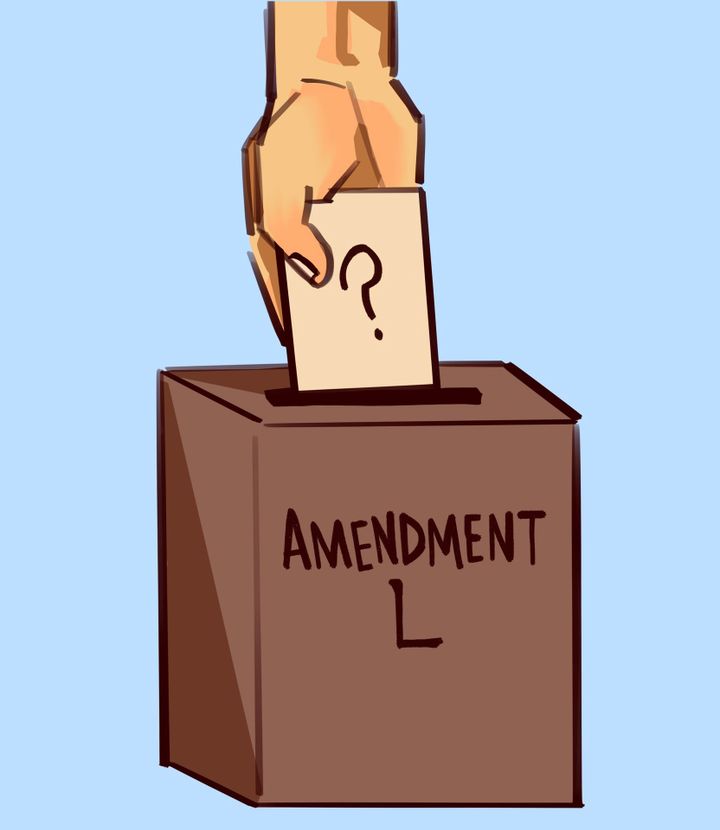
Should voting be mandatory for all US citizens?

The right to vote is one of the most important, fought for and protected rights in the United States. It’s also the most direct way an individual can impact public policy, whether that be locally or nationally.
Today, voter turnout in the U.S. is about 60% of the registered voter population during presidential election years and 40% during midterm elections. This is a much lower percentage than historical voter turnout.
Some argue that current voter turnout is a result of economic disparity, a lack of transportation and limited accessible information about candidates and proposals.
But what if voting was mandatory?
Proponents of mandatory voting argue that if everyone must cast their opinion, it could lead to a more accurate representation of the U.S. population.
Others say that robbing people of the choice to vote by making it required is undemocratic. Moreover, a mandatory vote doesn’t mean voters are making an informed decision. Other countries have instituted compulsory voting since the turn of the 20th century. Maybe they’re onto something.
With the midterm elections fast approaching, Augustana’s student voters must decide whether or not they will prioritize getting to the polls, stamping their mail-in ballots or simply completing their assignments and getting to class. Either way they will be exercising their right to vote, but should that right be an optional one?
Below, two students argue their stances on whether or not voting should be mandatory in the U.S.
Elsa Friesen, Forum Editor

No, it discourages democracy
Luz is a junior journalism, government and international studies triple major.
In the United States, voting is optional. However Brazil, my home country, has one of the strictest mandatory voting systems in the world. Growing up under this system is exactly why I am against mandatory voting.
I registered to vote at 16 when voting was still optional. Although voting becomes mandatory at 18, I wanted to participate in my country’s politics because I understood the importance of civic engagement. To me, voting is a right, and making it an obligation risks losing exactly what makes it democratic.
Democracy is based on the consent of the people. When I vote, I choose who I want to represent me. That choice only has value because I am free not to participate. Countries with mandatory voting like Brazil, Belgium and Australia are still democracies, but I don’t believe the act of forcing citizens to vote is democratic.
If the goal of an election is to show the will of the people, compulsory voting gets in the way of that. It increases turnout but doesn’t show whether those votes represent anything. In Austria, economists compared elections from 1949 to 2010 and found that compulsory voting increased turnout by about 10 points but didn’t change election results. Those who voted only because they had to tended to be nonpartisan and uninformed.
These uniformed votes count the same as the vote of someone who spent hours researching candidates. But when a person stays home it at least sends a message: parties know they haven’t won that voter’s support, giving them an incentive to win them over. This is one of the issues with compulsory voting: it can conceal party apathy by bringing disengaged citizens to the polls without giving parties a clear reason to win their support.
To force someone to vote, the state must punish those who don’t. In Brazil the fine is symbolic, but anyone who misses three elections in a row without justification has their voter registration canceled. Without it citizens cannot obtain a passport, ID or apply for civil service jobs.
The state treats voting as so important that it must be mandatory, but then punishes non-voters by taking away their right to vote. A right that costs you other rights when you don’t exercise it is no longer a right.
Of course, supporters of compulsory voting have a valid concern: without the obligation turnout would fall, leaving elections dominated by wealthier and more educated citizens. Low-income voters often have less access to information and can have difficulties getting to the polls.
In these instances, compulsory voting is like a band-aid. It puts people at the polls without addressing why they wouldn’t show up if given the choice. Instead, the government should provide more information to voters and provide transportation.
With the Nov. 3 elections approaching, it’s worth remembering why we vote in the first place. People want their voices to be heard and their participation to matter. Voting gives us a say in who governs us, but that power means more when exercising it is a choice.
No one forced me to vote when I was 16. I chose to participate, and that freedom is what made voting meaningful to me. Voting is a right, not an obligation.

Yes, it’s our civic duty
McGowan is a junior environmental studies, government and international affairs and French triple major.
In America, the right to vote is the most fundamental expression of the principle of “rule by the people.” While there are various ways to engage in participatory democracy, such as petitioning politicians, donating or volunteering for campaigns and running for office, voting is the most direct, concrete and egalitarian.
However, the notion of “We the people” expressed by our constitution is undermined when only a portion of the people exercise their voting rights.
Legally establishing voting as a civic duty as well as a right is the clear solution to connecting every citizen with the government that claims to represent them.
Voter turnout in the U.S. usually ranges from 40-60%, with midterms typically drawing fewer voters. The drawbacks of low voter turnout are obvious: if only a portion of the population votes in an election, the elected official can’t truly represent that population. This calls the legitimacy of the elected government into question.
However, this is not simply an issue of abstract legitimacy. An article from Econofact shows the discrepancies in voter turnout based on income, with higher income consistently correlating with higher voting percentages. If the wealthy are voting more often they are being better represented in the government, and therefore have disproportionate power compared to other citizens.
There are several possible explanations for why low-income Americans vote less, including limited free time to think about politics or unequal access to civic education. An especially important reason is that they may feel disenfranchised within a system that seems to favor the wealthy and believe their votes won’t matter. Expecting all citizens to take responsibility in their government with a mandatory vote could empower them to see themselves as part of the political process.
Critics also argue that mandatory voting infringes on liberty. This argument is difficult to justify without also attacking the well-accepted American custom of compulsory jury duty. The requirement of random citizens to participate is what gives criminal convictions legitimacy as societal judgements.
Participating in a jury is seen as a civic duty because it helps ensure that verdicts reflect the judgement of the community. We should give elected positions legitimacy in the same way.
Critics sometimes cite the danger of increasing the number of low quality votes: those randomly cast by people who vote out of obligation without putting in the due consideration. This is a real possibility, but it is less of a threat to genuine representative government than a lack of representation altogether.
Furthermore, a mandatory voting policy doesn’t need to be implemented in isolation. Coupled with increased civic education, it would promote well-informed voting as a core civic duty.
The penalties to enforce mandatory voting don’t need to be draconian. Small fines, proportional to income level, would have the effect of establishing that voting is expected of citizens as a duty without threatening to ruin people’s lives if, for whatever reason, they really don’t want to.