Inside Augustana athletics’ filings: What 6 years of federal EADA data reveals
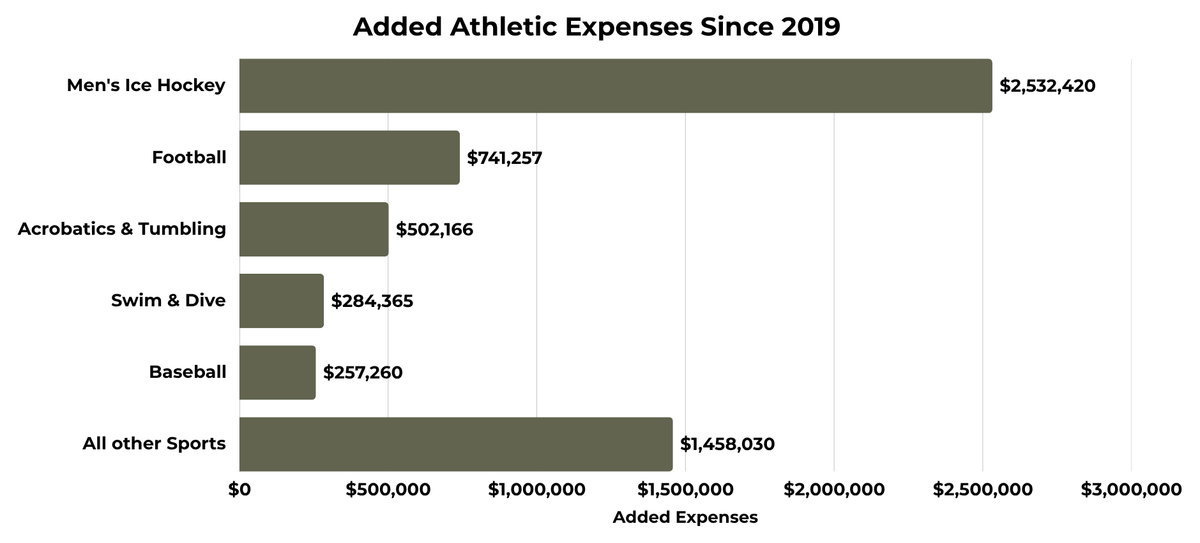
Between 2019 and 2024, Augustana’s annual spending on athletic teams rose by nearly $6 million. Over those years the university built a $72 million arena, launched Division I men’s ice hockey and added women’s acrobatics and tumbling.
Six years of Equity in Athletics Disclosure Act (EADA) data show how that expansion reshaped Augustana athletics and how spending was distributed across the department.
Hockey tipped the spending split
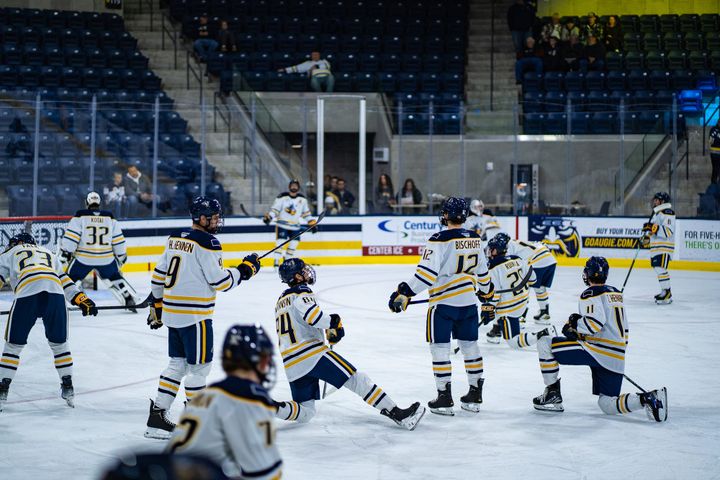
Augustana’s two newest sports came with very different price tags. In 2024, Division I men’s hockey cost $2.53 million in team expenses, about $93,800 per athlete. Women’s acrobatics and tumbling cost $502,000, or roughly $12,000 per athlete.
“Having a Division II multi-sport program with one Division I sport: it’s going to be different,” Athletic Director Josh Morton said. “Our hockey program competes against the Big Ten, so we have to compete and benchmark that way.”
From 2019 to 2024, total expenses across all teams rose from $8.41 million to $14.19 million. Men’s programs absorbed 73% of the $5.78 million increase, with hockey alone accounting for nearly half.
Morton said the increase reflects both the addition of new programs and rising costs across the department. Travel is one of the largest expenses, he said, with fuel, hotels and food all becoming more expensive over the past several years.
As total spending increased, women’s programs’ proportion of expenses fell to 37% in 2024, down from an average of about 44% over the previous 15 years. This was the lowest proportion since 2005.
Among NSIC schools with Division I men’s hockey, Augustana spent the least proportionally on women’s programs in 2024. The other four ranged from about 41% to 47%, though all four are public universities that also have Division I women’s hockey.
Female athletes received more scholarship dollars per athlete
In 2024, women made up 60.8% of Augustana’s undergraduates but 39.6% of its varsity athletes, the largest enrollment-to-participation gap among NSIC schools with Division I men’s hockey.
Despite the participation gap, female student-athletes received more athletic scholarship money per athlete in 2024. Augustana awarded $7.12 million in athletic student aid, with female athletes receiving an average of $13,930 compared with $11,704 for male athletes, a $2,226 difference.
Senior softball player Ella Cooper said roster size can affect how scholarship money is distributed.
“We are very, very lucky in the softball world, and we get great athletic scholarships because our roster is so small,” Cooper said.
Augustana pays its coaches less
Men’s head coaches at Augustana averaged $103,636 in 2024, compared with $66,304 for women’s head coaches, a $37,332 gap. Augustana’s men’s coaches earned 56% more than its women’s coaches. The gap was 88% at Minnesota Duluth, 69% at St. Cloud State, 52% at Bemidji State and 51% at Minnesota State.
Much of Augustana’s gap is driven by the addition of Division I men’s hockey. Hockey coach Garrett Raboin received $257,200 in total compensation in fiscal 2023-24, according to Augustana’s 990 filing. Excluding Raboin, men’s head coaches averaged about $82,000 in 2024, roughly 3% higher than the $79,839 average in 2019. Women’s head coach pay, meanwhile, fell from a peak of $72,552 in 2022 to $66,304 in 2024.
Cooper said the pay gap still doesn’t sit right with her.
“It’s not fair,” she said. “The amount of time these coaches have to put in is about equivalent, whether it’s men’s or women’s sports.”
Augustana had the lowest average head-coach salaries of the five schools examined. Men’s head coaches at the four public peers averaged between $171,136 and $279,778, while women’s head coaches averaged between $106,149 and $148,912.
Morton attributed some of that difference to Augustana’s private status.
“Comparing private schools to public schools is oftentimes a challenge. There’s just inherent differences,” Morton said. “Private schools, we have to generate things on our own.”
He added that salary is only one factor in retaining coaches.
“There’s always going to be the potential for more salaries somewhere else,” he said. “So there’s got to be something else besides that.”
For new softball coach Colleen Powers, Augustana’s culture was part of the appeal.
“I love that it’s a small university that feels big time,” Powers said. “The community gets so excited about the sports teams here and the winning.”
What the data can’t tell us
Federal filings provide a detailed look at how Augustana’s athletic spending changed, but they leave some questions unanswered.
That’s partly because Augustana is a private university. Its EADA filings and IRS Form 990 provide a public window into athletics spending, but public universities face additional disclosure requirements.
When the University of Minnesota hired longtime Augustana softball coach Gretta Melsted in May, for example, her five-year contract became public. It lists a $180,000 starting salary and an annual pool of $327,590 for assistant coaches and staff. Augustana, in contrast, is not required to disclose what it paid Melsted.
The EADA reports and tax filings also don’t show how much of each team’s revenue comes directly from the university, how much programs raise themselves or whether any programs fully cover their own expenses. The filings show where Augustana spent its money, but not the full picture of where that money came from.