"Obsession" delivers on every level
“Obsession,” directed by Curry Barker, proves you don’t need a nine-figure budget and a star-studded cast to make one of the year’s biggest hits — you just need to nail the basic elements of filmmaking.
Rarely does a film manage to land every element — writing, cinematography, score and acting — all at once. “Obsession” does exactly that, and the result is one of the most striking horror films in recent history.
The film explores psychological terror in a way that hasn’t quite been done before in American cinema, turning the tangled web of love and desire into one of the most beautiful, overwhelming nightmares on screen today.
“Obsession” opens with Bear (Michael Johnston) too afraid to admit his feelings for longtime coworker and friend, Nikki Freeman (Inde Navarette). In a moment of panic and regret, he turns to a mysterious artifact called the One Wish Willow and wishes that Nikki would love him more than anyone else in the world. Nikki’s attitude towards Bear and his affection flips instantly and the two begin to spend all their time together. For Bear, it’s a dream come true, but soon Nikki’s love begins to curdle into something that is at first possessive and later psychotic.
Navarrette and Johnston master the art of nonverbal expression in this film with their explosive performances. Navarrette achieves this with her intense, euphoric smiles and endless eye contact with Bear, while Johnston’s empty, defeated stares and crippling mannerisms reflect his growing fear of Nikki post-wish.
As Nikki slowly slips from adoring to unhinged, the film ratchets up its suspense. A lot of that tension comes from the score.
Composed by Rock Burwell, “Obsession’s” score consists of haunting electronic synthesizers and hardware-driven sound design. In many parts of the film, the volume steadily increases for what feels like forever, making the story unpredictable. Hearing these eerie compositions in the theater made me feel like I lost all perception of time, which highlights Burwell’s skills as a composer and Barker’s one-of-a-kind vision.
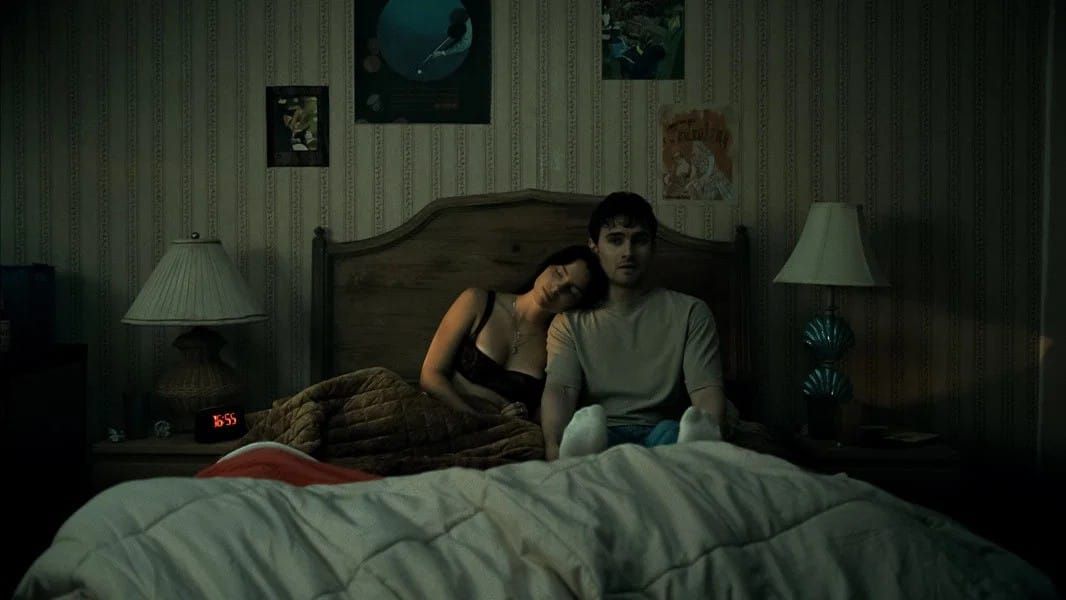
Much of the film is shot in narrow frames with dark lighting and heavy shadows. This makes it difficult at times to even see a character’s face. This low-light cinematography is notoriously hard to pull off, and here it becomes central to the film’s identity. The scene of Nikki running toward Bear is a great example of this. The darkness surrounding Nikki makes the scene even more tense. This sort of small detail speaks to how deliberate Barker’s vision for the film was and cinematographer and director of photography, Taylor Clemens, deserves credit for nailing these narrow-frame, low-light shots.
Leaving the cinema, I felt impressed and satisfied by a film for the first time in a while. So often I leave feeling as if I wasted my money watching some same old regurgitated story. My only gripe: there is one scene involving a feline that my fellow cat lovers will cringe at.
Regardless, Barker’s cinematic art is a true, unique gem. The film explores ideas like the bittersweet duality of love and why one must be careful what they wish for — timeless lessons that no doubt contributed to its record-breaking success.
“Obsession” started off with a production budget of $750,000 and evolved into a more than $500 million phenomenon, showing that when love turns into obsession, there’s no telling how far it will go.