Athletics adopts AI software to speed up content creation
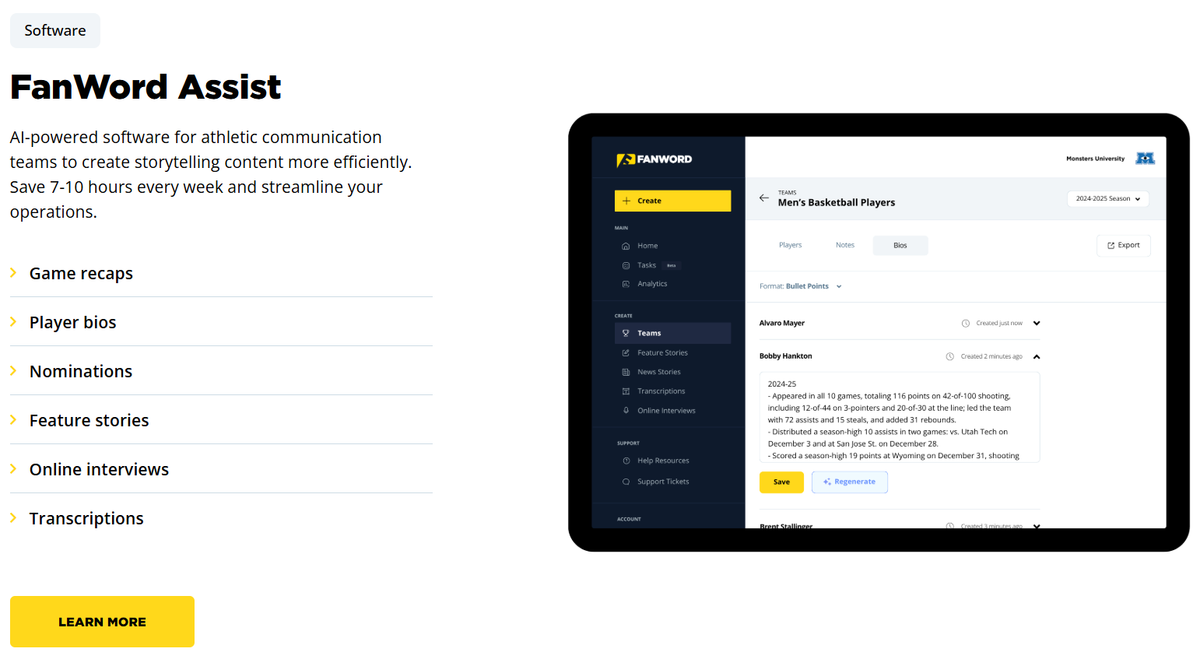
This summer, Augustana Athletics signed an agreement with the artificial intelligence software company FanWord to assist in communication operations.
The Vikings join a roster of more than 200 sports organizations across all three NCAA divisions and the National Association of Intercollegiate Athletics (NAIA), including fellow NSIC schools Minnesota State Mankato and Minnesota Duluth.
The partnership was formally agreed to this July following a webinar demonstration last spring intended to show the athletics department what the platform offers and how it operates.
Designed specifically for collegiate sports, the “FanWord Assist” program uses box scores, roster data and player histories to generate game recaps, feature stories, athlete biographies and more.
“FanWord automates initial drafts of routine content,” Nicholas Rappuhn, newly appointed assistant athletics director for communication, said in an email. “We use it as a drafting engine — it pulls in stats and data to get a story about 80% done, allowing our staff to polish and publish in a fraction of the time.”
According to a press release on the GoAugie website from July 15, the program’s purpose is to “help communications staff create high-quality editorial content in a fraction of the time” with the “long-term goal of telling more meaningful student-athlete stories.”
Time and efficiency were two key components in switching to the platform. Over the past few years, Augustana has seen an increase of more than 200 in student athlete ranks across 22 sports, including a move into Division I men’s hockey. With only two full-time communications staffers and a video director, covering every team became impossible.
“Our department has grown exponentially,” said Josh Morton, vice president of athletics. “So the question was, ‘How do we continue to offer the same level of communication and celebration of what our athletes do?’ So this [partnership] was a good way to take away some tedious work, and I think the technology has finally gotten to a place where we felt comfortable with it.”
Last year, because of limited time and resources, the communications team turned away from writing game recaps and focused solely on covering championship competition. Now, with FanWord Assist in the picture, Rappuhn said they can “highlight every student-athlete and the success they bring to Augustana.”
Rappuhn said, FanWord’s own tracking shows 70 hours saved in just over a month while also creating over 225 bios for the 2026-27 season.
Jared Rubado ‘18, now the sports editor of the Bemidji Pioneer, spoke about the workload he observed among sports information directors (SIDs) at Bemidji State — a fellow NSIC school that recently adopted FanWord Assist.
“The SIDs are truly the most underappreciated people in athletics,” Rubado said. “They’re working 15-18 hour days for hardly liveable wages. It’s hard for people to see what really goes on behind the scenes, but there is no reprieve.”
For this reason, Rubado said he’s sympathetic to their plight and understands why an AI platform like FanWord is an appealing tool. However, he expressed concern over the quality of these AI-generated stories.
“I think the biggest flaw is that you can tell if something’s not proofread. If an SID doesn’t thoroughly proofread it, there are probably going to be some mistakes,” Rubado said. “Not so much with stats because AI is likely pulling from a box score, but the recap is going to be written poorly.”
Morton emphasized the time and energy FanWord’s generative functions save the communications team.
“It’s just a lot of work for them,” he said. “Whereas if there’s an AI component that can help that’s pulling the same data, you can do it much faster and it frees you up to do more important things and tell more stories.”
“FanWord talks about amplifying players' voices and storytelling and the athletes, and you can’t do that in the realm of AI, in my opinion,” Rubado said. “If the work isn’t being done by humans, there isn’t a way to streamline it where you can trust that the work is correct in the end.”