Letter to the School of Music
When this soapbox is published on the morning of Friday, May 8, I will be in Des Moines with over 150 other students who participate in an ensemble for the School of Music.
This is my second year in the Augustana Choir, and it is impossible for me to explain how deeply I have enjoyed the vast majority of the time that I’ve spent making music with my director and peers. The privilege to perform beautiful repertoire with musicians whom I love and respect is not one that I have taken for granted.
Despite being a non-music major who does not receive a large scholarship for my participation, I have dedicated countless hours of my time to the Augustana Choir over the past two years. I have done so because I love music. I love to sing, and I love to sing with others. For me, it is as simple as that.
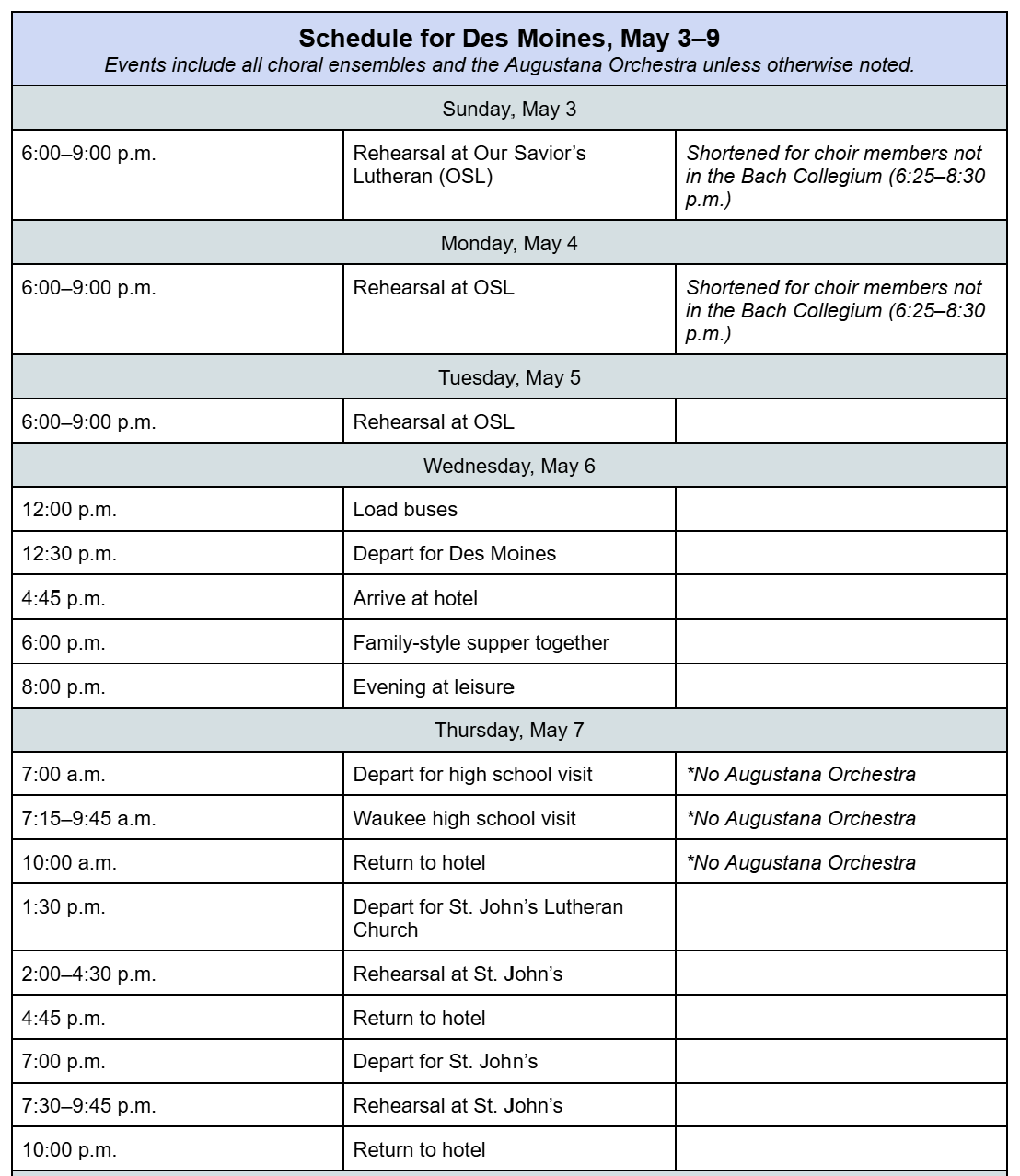
However, something has changed with this trip to Des Moines. Never before has the School of Music asked for so much of my time during such an academically challenging part of the year, nor have I been asked to learn such difficult repertoire in this short of a period of time. Moreover, this trip was not included on the original syllabus, which typically lists all important concert and tour dates for the entire academic year; it was announced during the latter part of the fall semester.
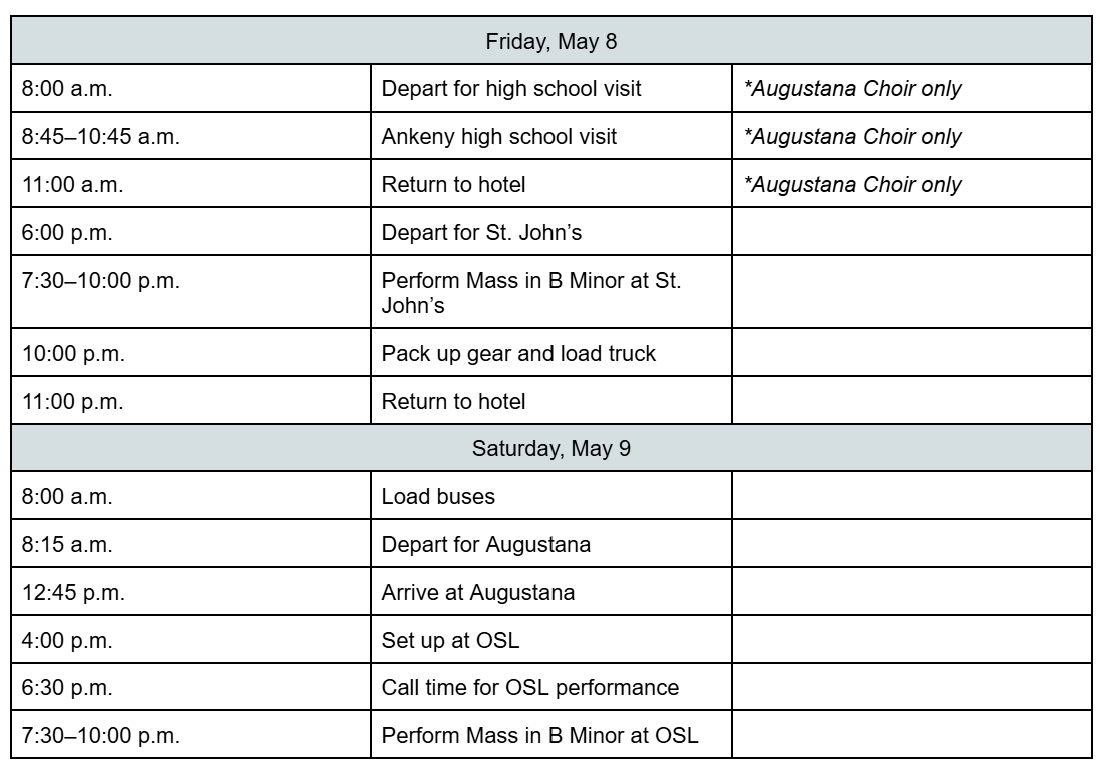
It must be said that in terms of time commitment, choir is a demanding extracurricular. Regular rehearsals are 80 minutes long, four days a week. Last year, the Augustana Choir performed three concerts per semester; this year, we have done two per semester. Each performance requires at least one dress rehearsal, and big concerts which feature multiple ensembles — like Vespers or last year’s St. John’s Passion — often require the addition of other night rehearsals during the week prior to performances. For the past two years, we’ve spent the first three days of our spring break on tour in Minnesota as part of the Tiårasang project, and we also perform our repertoire at various chapel and church services.
Rigorous time commitment, then, is a typical and well-understood requirement of participation in the Augustana Choir, as with other musical ensembles. Despite that fact, these final weeks of spring semester in my senior year mark the first time that I have felt disrespected by what the School of Music is expecting from me.
First and foremost, I am at Augustana for my academics. Asking me to miss two and a half days of classes during any time of the year would be significant, but to ask me to do so one week before finals and two weeks before my graduation feels unreasonable. I cannot and will not disregard the fact that I am a student. It is my first priority. It is why I attend the university.
For this trip, we are expected to miss multiple academic days: Wednesday, May 6 (anything later than noon), through Friday, May 8. I consider myself somewhat lucky in comparison to many of my peers. I have understanding professors, and my English and Spanish majors of grade largely by written assignments, which I can submit online. I have friends, however, who do not have this luxury. Some are indeed missing exams, others important presentations.
Even though my majors and professors allow me to be flexible, I am continuing my usual work without the advantage of being on campus: essays to write, presentations to plan, stories to edit. The majority of the students here in Des Moines are not music majors; for us, a trip like this is solely extracurricular. We must work around our physical absence from campus to continue our academics and fulfill other extracurricular obligations as everything wraps up for the semester.
We are mere days away from spring finals, and many of us, including me, are just weeks away from graduation. This is a time of year when students are already struggling to divide their time effectively amongst commitments which all seem to require their attention. And yet, we as participants in musical ensembles are being asked not only to leave campus for multiple days — but to rehearse and perform a musical setting that is widely considered to be one of the most vocally challenging ever written.
It is hard to explain the magnitude of Bach’s Mass in B Minor to a non-musician. For a vocalist, it is simultaneously a marathon and a sprint. Frequently, the tempos of the pieces inside it are punishingly fast, but the music itself is far from easy. Melisma (a string of multiple pitches on a single syllable, like a run or riff in modern music) appears on nearly every page. Wide jumps between notes, like octaves, are common.
Essentially, with a runtime of over two hours, the Mass demands vocal agility, precise breath control and incredible stamina. When performed well, the end result is stunning, but to put it on is a monumental undertaking.
It must be understood that I am not objecting to the performance itself of the Mass in B Minor. In fact, there have been moments in the past few days during which I have found myself captivated by the way the music has come together. “Cum Sancto Spiritu” is nothing less than a joy to hear. “Crucifixus” is delightfully dramatic. “Sanctus” is an exhilarating and beautiful challenge. At times, when the music swells around me, I am reminded of the reason I am in choir in the first place.
The immensity of this music, though, is exactly what makes its performance no small feat. The choral members of the Bach Collegium — all of whom are also part of the Augustana Choir — sing the entire Mass, with the exception of the solos and duets, which are performed by guest vocalists.
The other three choirs only perform certain sections. The Augustana Choir has been learning and performing other repertoire for the majority of the semester, so the first time I laid eyes on our portion of the music was about six weeks ago after we completed our final concert on March 21. At that point, our Bach Collegium members also had not yet rehearsed some of that music.
Needless to say, learning the Mass in B Minor in less than four months is a serious endeavor. It has indeed come together impressively, and we should be proud of that. But I find myself here on the day of our first performance, trying to balance my other obligations, and I wonder how this project might have been made less strenuous for us students.
I graduate in 15 days. No matter when future performances are scheduled, what music is being presented or how much time students have been given to learn repertoire, I will not be affected. I am not writing this for myself. I write it for returning and future ensemble students in hopes that they will not have to undergo the same stressors that I have this spring.
To the School of Music: I ask you to consider your future planning carefully.
I urge you to remember that your students are students, first and foremost. The burden of days of missed classes is not one that they should have to bear at this time in the semester. Let them have this time of year to worry about their finals, write their essays and plan their graduations.
Take into consideration that many of your students are not music majors. Their participation in ensembles is extracurricular. It is already above and beyond. Recall that their time at university could be dedicated to a thousand other things, and they have chosen you.
When selecting difficult repertoire, account for the mental and physical energy required from students to learn it. Even if it is possible to shorten the time frame for learning repertoire, it may not always be wise. Allow your students time to breathe.
Thank you for your time in reading this letter, and thank you for giving me each of those moments during which our music touched my soul. I will carry them for the rest of my life.
With respect,
Jocelyn Baas