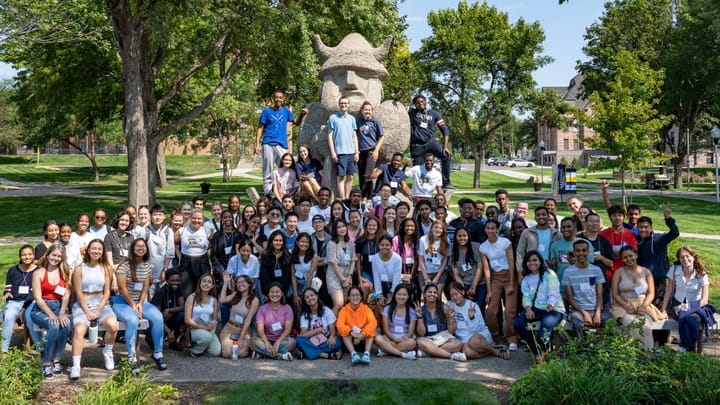
Enrollment growth persists in face of demographic cliff

At a time when universities nationwide are feeling the effects of a demographic cliff, Augustana’s fall 2026 admissions is projected to enroll 600 incoming freshmen and reach a headcount of 2,600 students by next school year.
Despite national declines in private four-year college enrollment due to the Great Recession at the end of 2007, Augustana’s numbers have been climbing in the opposite direction, including a record number of 615 freshmen last fall. The university’s projected growth is paired with high retention rates, including a percentage of 85.9% in the freshman fall class of 2025, the second-highest rate in Augustana history. As the university looks ahead to fall 2026, the increase raises questions about campus space and resources.
The challenge comes at a time when higher education is facing what is called the demographic cliff, a decline in school graduates and college applicants that began in 2025. An analysis by one higher education consulting firm shows projections of a 13% drop in 18-year-olds entering college between 2025 and 2041. The decline in enrollment, which was 15% between 2010 and 2021, is expected to increase, with some estimating that up to 80 additional colleges could close annually nationwide.
Jon Marcus from Hechinger Repert shows the Midwest region has been hit the hardest, with declines of 20%, compared to the South with a 3% increase. Augustana has adapted to this shift by diversifying student demographics and improving retention rates.President Stephanie Herseth Sandlin said students have been drawn to the university’s success and the opportunities it offers.
“Athletics and the arts are important to this community of Sioux Falls,” Herseth Sandlin said. “Augustana has had success in these fields and offers such diversity of programming.”
Adam Heinitz, associate vice president for enrollment management, said the university's growth is connected to local factors.
“As Sioux Falls grows and we continue to be the largest university in the city, part of it is being able to serve more students because there will be more people here and the city has needs in terms of educated workforce in certain areas,” Heinitz said.
He also discussed shifting preferences for students, adding that students have been drawn to schools with higher enrollment that provide more opportunities.
“Students like colleges that are a little larger so we’re never going to be huge, but certainly we’ll always have fluctuations in growth,” Heinitz said.
Still, the university’s long-term growth plan of 3,000 students is not just focused on undergraduate enrollment. Heinitz said much of the projected increase will come from graduate programs.
“When we talk about Augustana’s growth, that’s 600 to 800 graduate students and 2,200 to 2,400 undergraduate students,” he said.
Even with that balance, some of the pressures of growth are already being felt on campus.
Freshman Karalyn Leach said she’s already noted some crowding on campus in the main areas.
“Since arriving on campus, I have noticed the effects of the large incoming class,” Leach said. “Oftentimes the dining hall is very full, and it can sometimes be difficult to find an
empty study room.”
She added, though, that Augustana's growth could provide new opportunities.
“I see Augie’s push for more students as a positive thing because it can bring in new
perspectives, more diversity and overall more widespread opportunities on campus,” Leach said.
To help meet demand, Augustana is opening a new apartment building called Foundation Heights this fall, adding just over 100 beds. Heinitz said the university expects to meet housing needs for fall 2026, though additional expansion could be needed in the future.
Junior Gabrielle Erickson, who works in admissions and gives campus tours, said she has seen a noticeable increase in students visiting.
“I would say typically in years past we would see more juniors and seniors, but there’s been a lot of sophomores and even some freshmen that have started to look into colleges earlier,” she said.
Erickson added that this increase could open new opportunities for students.
“Augustana offers the chance to take classes outside of your major,” Erickson said. “Larger universities don’t have that kind of freedom that Augie provides, which is one of the reasons why students are starting to become drawn to the liberal arts education.”
As Augustana works toward its fall 2026 enrollment goals, its growth reflects both progress and uncertainty. While increasing enrollment and strong retention rates show a demand, the university still has to balance that growth with the physical realities of campus life.
“I think overall it’s positive because it speaks to the momentum that we have as a university, and students want to be a part of something that is growing and thriving,” Heinitz said. “Like with anything when you grow, it depends on how fast you accomplish that, and with that comes growing pains.”