
‘Project Hail Mary’: The next ‘Interstellar’-level film
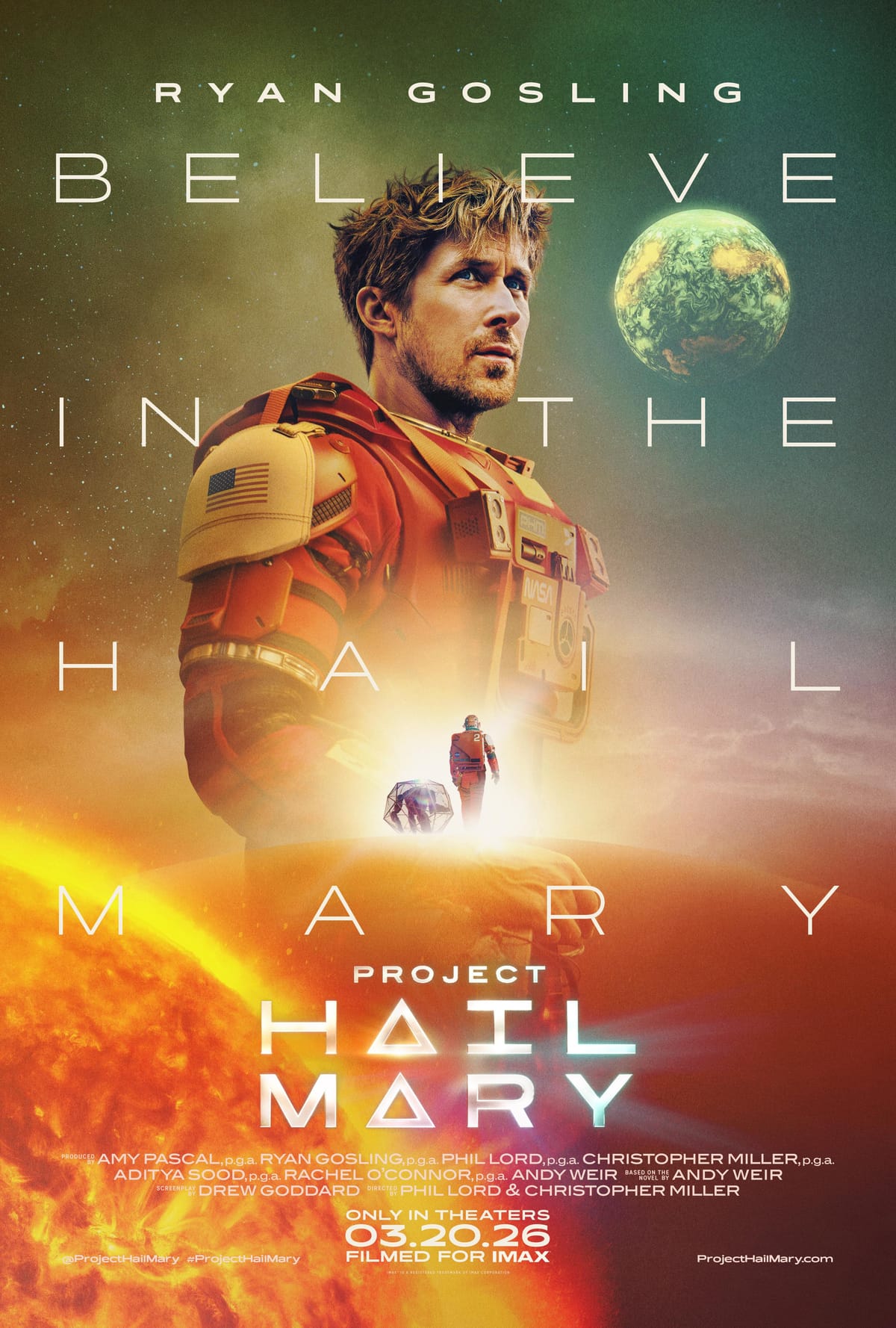
Directed by Phil Lord and Christopher Miller, “Project Hail Mary” is a science-fiction adventure that blends high-stakes survival, mind-bending puzzles and unexpected humor, earning it comparisons to the scope and ambition of Christopher Nolan’s 2014 film “Inception.” Like Nolan’s space epic, it challenges viewers to stay engaged with both complex ideas and emotional stakes, making the journey as thrilling as the ultimate goal.
Both films share a similar sense of scale, using science not just as a backdrop but as a driving force behind the story’s tension and emotional weight. Where “Interstellar” explores love and time across galaxies, “Project Hail Mary” finds its strength in problem-solving and connection, grounding its massive premise in something deeply human.
The story begins with Ryland Grace (Ryan Gosling) awakening alone aboard a spacecraft with no memory of who he is or how he got there. As he pieces together fragments of his past and recalls the mission he’s been assigned, the narrative shifts between present-day isolation and key moments from his life on Earth.
These jumps are handled smoothly, revealing information at a pace that keeps the audience learning alongside Grace without feeling disjointed or confusing. The structure adds an element of mystery early on, turning even small revelations into impactful moments that reframe what the audience thinks they know.
Gosling anchors the film with a quietly expressive performance that carries much of the story on his own. His subtle humor, moments of frustration and flashes of vulnerability make Grace a relatable guide through both the emotional and scientific challenges of the mission.
While much of the early runtime emphasizes his solitary experience, the introduction of an unexpected companion, Rocky, transforms the story into something more collaborative. This dynamic adds warmth, humor and surprising emotional depth that complements the high-stakes tension. As my cousin said, “The rock has more empathy than most people.”
Adapted from the 2021 novel by Andy Weir, the screenplay leans into scientific detail without feeling inaccessible. Complex ideas are explained through clever visual cues and dialogue, making the technical aspects engaging rather than overwhelming. The story finds tension in ingenuity and problem-solving, turning each challenge into a thrilling intellectual puzzle that draws the audience in. Even when the film dives into dense scientific concepts, it never loses sight of the characters at the center, ensuring that each solution feels earned rather than purely theoretical.
Visually, the film is immersive and grounded. The spacecraft interiors feel lived-in and functional, while the vastness of space is captured sparingly but effectively, emphasizing both isolation and wonder. The cinematography, production design and restrained use of visual effects all work together to maintain a consistent tone, balancing spectacle with intimacy.
The film’s score, composed by Daniel Pemberton, is exceptional. It flows seamlessly through moments of suspense, awe and quiet reflection, amplifying both the tension of Grace’s mission and the emotional resonance of his discoveries. The music often feels like an invisible character, guiding the audience through the story in ways that are hard to put into words — subtle yet unforgettable.
Pacing is similarly well-managed. Despite a story that could have felt slow due to its scientific focus, the film keeps momentum through carefully timed reveals, problem-solving sequences and the interplay between Grace and Rocky. Occasional stretches of exposition briefly slow the rhythm, but they are rare and quickly overcome by the story’s engaging flow.
What ultimately sets “Project Hail Mary” apart is its sense of optimism. In a genre often defined by destruction or despair, the film leans into cooperation, curiosity and the idea that understanding — whether scientific or personal — can be a powerful force for survival. That perspective gives the story a refreshing tone, allowing it to feel both urgent and hopeful at the same time.
By the time the credits roll, “Project Hail Mary” leaves a lasting impression not through the spectacle of a space setting alone, but through curiosity, connection and perseverance.
This is a film that trusts its audience to engage with ideas as much as emotion, resulting in an experience that is intellectually stimulating, emotionally resonant and surprisingly heartwarming — truly earning its “Interstellar-level” comparison. It lingers long after viewing, prompting reflection on both its science and its heart.