Order in the recital hall: Augustana to host SD Supreme Court
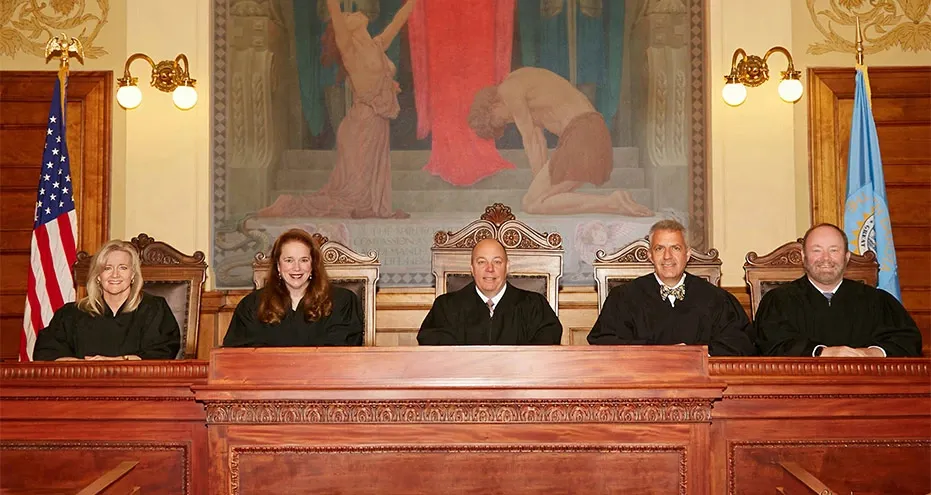
For the first time in recent history, the South Dakota Supreme Court will hold hearings open to the public at Augustana. On March 18 and 19, the court will come to hear oral arguments for six cases inside Hamre Hall.
The two-day event is part of the court’s travelling term, a tradition in which justices hold public hearings twice a year across the state. The fall term is held at the University of South Dakota every year, but the spring term changes location.
“I think it’s important that people understand the judicial system and the legal system because it’s something they’ll more than likely have to deal with at some point,” second-year government and economics double major Lauren Murphy said.
While most legal disputes are settled in trial courts where evidence and facts of a case are presented, the SD Supreme Court functions differently.
To Chief Justice Steven Jensen, recognizing this difference matters.
“Hopefully people will have a better understanding of how the Supreme Court works,” Jensen said. “People will get to see how us as an appellate court work differently than a trial court.”
In an appellate court, no new arguments are made; instead, the court re-examines the validity of a previous court’s ruling. Decisions that are passed down can be used as legal precedents in future cases.
Unlike trial courts, which must hear every case filed, the Supreme Court has “discretionary jurisdiction.” This means that the court has authority to select which appeals it will review. While thousands of cases are processed in the lower circuit courts each year, the SD Supreme Court typically receives between 300 and 400 filings annually. Of these, just a fraction are actually selected for live oral arguments.
“We’re typically looking for cases where we haven’t addressed a similar issue in the past so it’s a new point of law,” Jensen said. “Otherwise it’s a case that’s significant to the public of South Dakota.”
At 8:30 a.m. before the hearings each morning, there will be a 30-minute period in which a judge and a court administrator will explain how the court works, as well as discuss the specific cases being heard that day.
There will also be a 45-minute period each day after all cases have been heard for members of the public to ask questions of the court.
“We can’t talk about the specific cases that day that were argued, but just general questions about the law that people have a chance to ask,” Jensen said.
For President Stephanie Herseth Sandlin, the event is a significant marker of Augustana’s success.
“I was honored that the Supreme Court would want to be on our campus and interact with our faculty, students and other members of the Sioux Falls community,” Herseth Sandlin said.
Herseth Sandlin also believes this event is for more than those interested in the legal field.
“You don’t have to be pre-law or a government major,” Herseth Sandlin said. “Be an interested and engaged citizen who gets to see the judicial system in action.”
Murphy shared this sentiment, noting the broad range of interests that could be represented.
“People should look into the cases and sit in on one they think could apply to them,” Murphy said. “You might learn something to be able to apply to just about every major.”
While this is a public event, all members in attendance will be expected to follow the expectations of a typical court session. Food and drink, hats, and the use of cellphones are not allowed while court is in session.
Audience members are not allowed to enter or exit Hamre Hall while a case is being heard. There will be a 10 minute period in between each case and the next to ensure people are able to come and go before each case starts.
Students should also be aware of the extra security surrounding Hamre Hall required to keep the justices safe.
According to Rick Tupper, Associate Vice President of Campus Safety, the east side of the humanities building parking lot will be blocked off. The spots in that section will be reserved for the justices, lawyers and participants in the cases.
The entrances available to students and the public will also be limited. The main Humanities door on the east side of the building will only be available for entrance into Hamre Hall. Only those planning to attend the court hearings will be able to use that door.
“Anybody that goes into that space will have to be screened, including going through a metal detector,” Tupper said. “There will also be a bag search. You won’t want to bring any weapons or even small things like pocket knives.”
The other doors in Humanities will be available for students and faculty trying to get to class.
“I would say it will be a little inconvenient, but it won’t limit people getting to their classes,” Tupper said. “Just the lobby and the Hamre will be blocked off.”
A QR code will also be available giving the details of the three cases each morning, and a webpage about the travelling term can be found on the South Dakota Supreme Court website.