Fellowship features faith during Black History Month
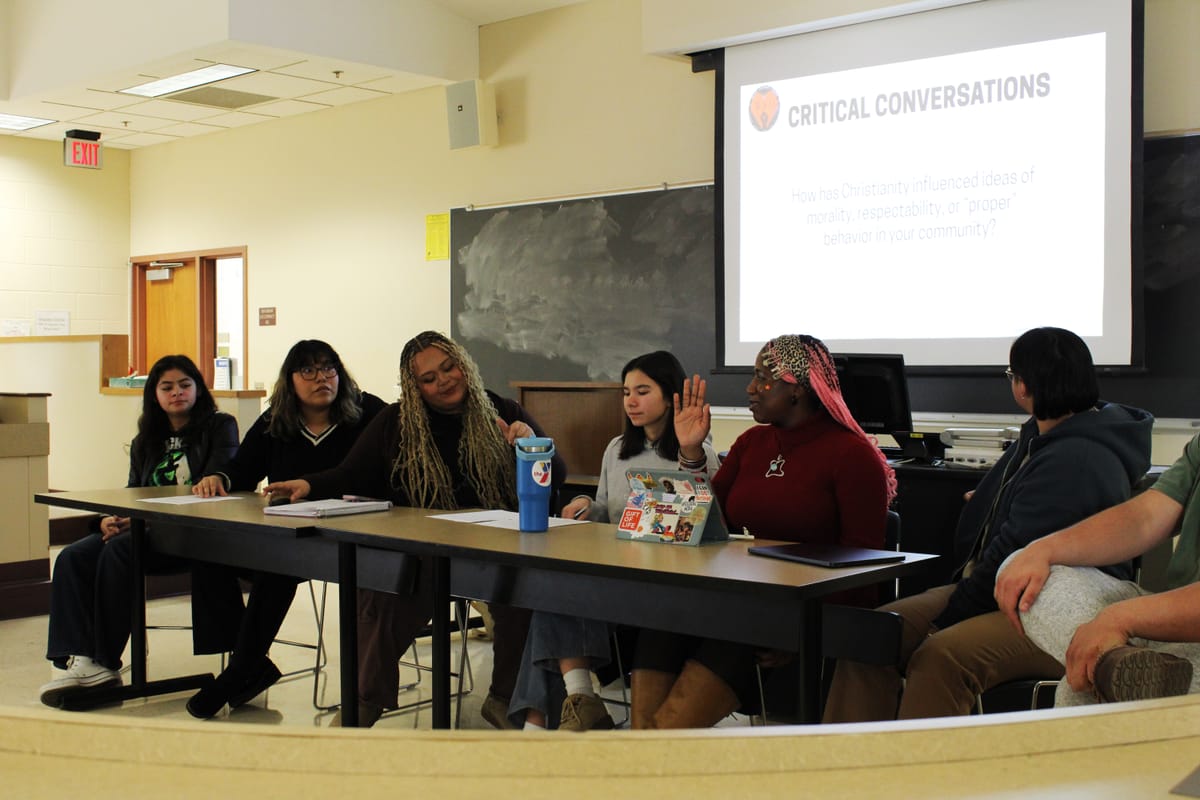
With sun seeping through the lancet windows, students sat in a peaceful lecture hall with eyes and ears dutifully attuned as they listened to one another’s stories of faith. Each voice echoed a different perspective on the repercussions of religion for marginalized groups. Though the topic is as old as time, it is one that remains convicting and transformative each time it’s discussed.
In celebration of Black History Month, Augustana’s Black Student Union (BSU) hosted a discussion panel titled “Critical Conversations: Religion in Communities of Color: Legacies of Enslavement, Colonization, and Forced Assimilation” on Thursday, Feb. 12.
Each person who sat in Madsen 201 shared a story from their communities and upbringings that informed how they see the world today.
The discussion was prefaced by a lecture from professor of sociology Will Swart, who believes students should be given a space for serious interfaith conversations to be held.
“It was participatory and democratic, and that’s what in part the university really ought to be about,” Swart said.
The Critical Conversations event series — created by Jenna Hageman, senior and president of BSU — is a series of meetings about different topics open to all students and faculty meant to guide those in attendance through thoughtful discussion. The series is inspired by conversations usually held behind closed doors, but it aims to embolden attendees to speak about their personal experiences publicly.
“Sometimes people can be scared to speak their minds,” Hageman said during the discussion, “but Augie is giving us an education so that we do that. They want us to be critical thinkers, and that’s exactly what we’re doing.”
These continued conversations are meant to encourage diverse discussion, inviting all students, faculty and the public to learn from one another’s perspectives.
“Today the conversation on religion is really essential. We specifically wanted to talk about Christianity because that’s been an oppressive tool for people of color,” Hageman said.
Faith takes a different form for all Augustana students, and the critical conversations held are a priority. For those who have been generationally impacted by Christianity across history, the conversation emphasizes the importance of critical thinking and intentionality regarding all faiths people practice.
“There should be more dialogue around religion, especially because Augie values itself on interfaith, and then these conversations need to be had,” Hageman said.
Beatrice Anyim, a senior and student in attendance, voiced passion for the event series.
“People should keep an eye out for events like this because this is how we grow as people,” Anyim said. “If you’re always surrounding yourself with the same things over and over again, there’s no room to think differently or see new perspectives, so I would encourage people to experience everything on campus because diversity is what’s going to enrich your life.”
The event acts as an encouraging space, expanding a diversity of conversations and inviting all students to learn from one another’s lived experiences. In doing so, it serves as a privilege to learn from one another.
However, Anyim shared she wishes to see more engagement from students.
“It would be great to see more people come,” she said. “We champion community, community, community, but not all communities are being engaged equally, and that’s just how I feel about it.”
For another student in attendance, junior Hannet Sedlak, diversity within critical conversations is key; moreover, embracing a person’s differences is the most important element of conversations such as these.
“If I could say anything to Augie students, it would be to push yourself outside your comfort zone in this aspect of conversation and in life,” Sadlek said. “Because you need to feel comfortable and be comfortable in the uncomfortable.”
Those in attendance lingered in the lecture hall as the conversations came to a close, reluctant to leave the room where laughter and reflection had filled each corner. It became proof that what began as another event on campus left attendees' minds illuminated and enriched from a diversity of perspectives.