Students voice concerns at Library Task Force town hall
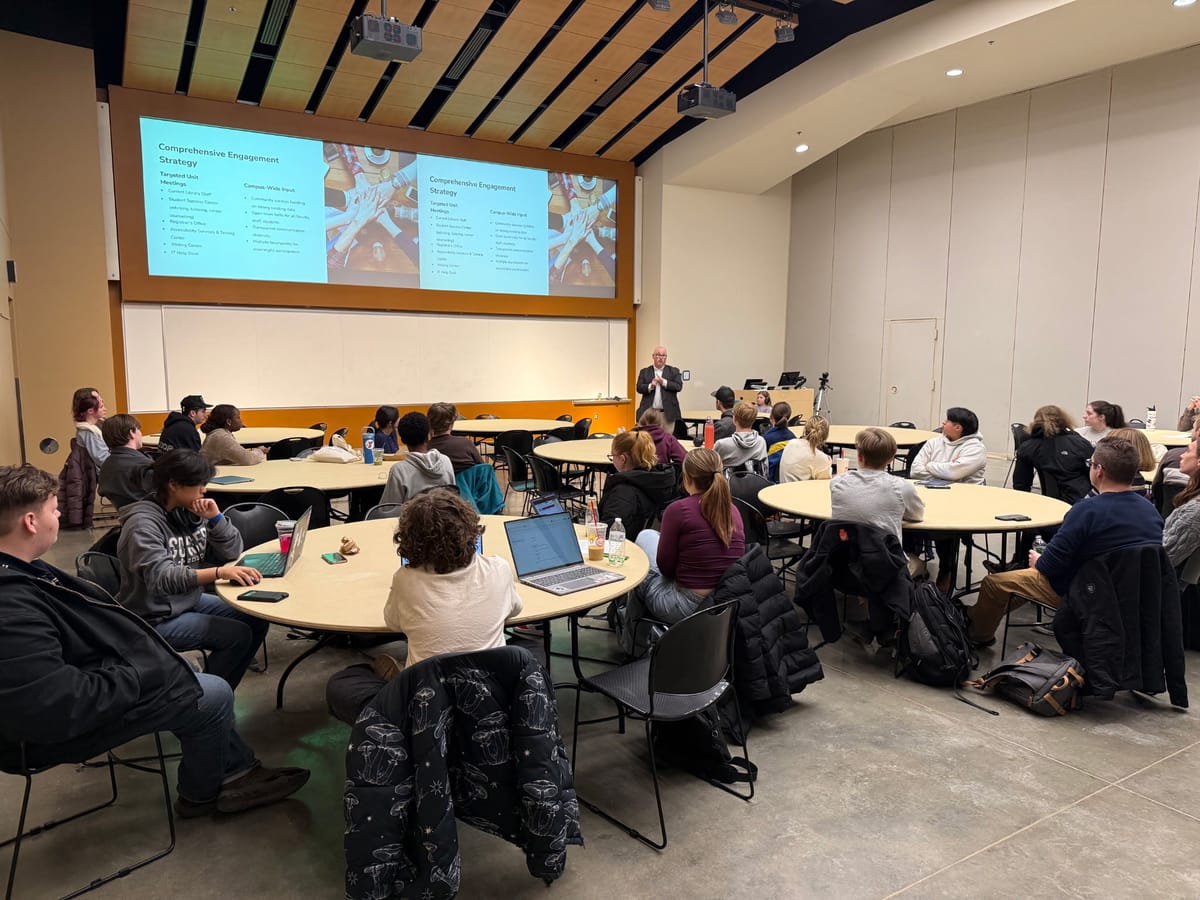
On Feb. 10, the Library Task Force hosted a town hall in the Froiland Science Complex where students could express their concerns and gain clarification on what will happen to the Mikkelsen Library. The event was the second in a series; the first, for faculty and staff, took place on Feb. 4, and the third, a virtual town hall for commuter students and faculty, took place on Feb. 18.
Approximately 20 students attended the town hall, which was led by Vice President of Innovation Peter Folliard. He began with a presentation, discussing the task force’s formation and the project’s timeline.
The mission statement of the task force formerly read, “Develop a plan and budget to reimagine the Mikkelsen Library as an integrated service hub for student learning, information, innovation and technology,” but Folliard emphasized that establishing a budget for the project is no longer a part of the task force’s mission. After the removal of “and budget,” the rest of the statement remains the same.
After Folliard’s presentation, time was allotted for student questions. Many different concerns were brought up, but study space, accessibility, and the safety and atmosphere of the library all repeatedly resurfaced.
Many students were concerned that changing major aspects of the library would negatively affect their ability to focus and study effectively. The first question expressed the student’s hesitation over the vagueness of the terms “innovation” and “integrated service hub.” When task force member and Director of Accessibility Services Jeff Merkle asked the students to raise their hands if they agreed that a quiet space conducive to studying was more important than technological innovation, they agreed nearly unanimously.
Later, one student expressed that students enjoy the library for the aesthetic it already has: the plants and art make the space conducive to studying, while open-concept AI reimaginings do the opposite. Another student agreed, stating that they enjoy the privacy many of the study areas have. Almost all students also seemed like-minded in expressing the need for study rooms.
Augie Access ASA Senator Madeline Larson asked if an ADA compliance audit would be conducted following any changes to the space, pointing out the lengthy construction at the front steps and the accessibility concerns such a project raises. The task force confirmed that such an audit would be part of the process.
After the town hall’s conclusion, sophomore biology major Ryan Schulte said that he attended to gain clarification following the recent swirl of speculation about potential change.
“There’s a lot of ‘We don’t know what’s happening,’” Schulte said. “We don’t entirely know — like, a lot of it is rumors, and I just wanted to know what’s true because I use the library nearly every day.”
Junior biology major Owen Bell said his reasons were much the same, citing the recent buzz on campus and his desire to “express [his] opinions.”
The Library Task Force acts as a sub-group of a broader Space Utilization Task Force, formed by the university a year and a half ago to audit on-campus spaces in order to maximize efficient use of available space. A significant portion of the Feb. 10 town hall’s time highlighted student questions about why Mikkelsen was chosen as a potential project site in the first place, but Library Task Force members responded to many by pointing out that answering these questions was out of the scope of their mission.
Some students expressed frustration regarding the scope of the public forum and confirmed that they would be interested in seeing similar meetings in the future, whether from the Library Task Force or otherwise.
“I want to know where they’re coming from in terms of choosing the library to ‘do over’ instead of other buildings,” Bell said.
Senior Evelyn Fiore also voiced mixed feelings.
“I think we really advocated for ourselves here, but I also feel like there’s this clash between administration and the student body right now,” Fiore said. “It was an important dialogue, though I don’t feel like we got any answers.”
Regardless of tension, Library Task Force student representative and junior Abby Smith said that she appreciated the support from students at the town hall. She pointed out the importance of student participation in events like the town hall.
“If given the opportunity to have input in decision-making and to play a part and be involved, having town halls like [this] kind of shows that students show up, even if it’s 20 or 25 or so,” Smith said. “So I think that's a major takeaway, you know — we need to give students more opportunities to be involved. It's a good thing, and it's healthy.”
Schulte agreed: if concrete changes are made to Mikkelsen in the future, he’d like to see students directly involved.
“Like when they’re actually deciding, should we move these bookshelves, should we toss these books over here or where should we put stuff — I really think that students should be included in that too because, again, we’re the ones who are using this nearly every day,” Schulte said.
Now that the town halls have been completed, the task force will move on to the next stage of the process. Though Folliard noted that it’s too early to know how information gained from community members will affect future planning, Library Associate Director Krista Ohrtman pointed out that “[students] affirmed some things that are priorities for us that will remain that way.”
Next, the task force will be analyzing the data gained from a recently concluded survey regarding student use of Mikkelsen’s space, which resulted in nearly 600 responses, according to Library Director Ronelle Thompson. The information gleaned from the town halls and the survey data will be instrumental in developing plans.